

[ Image- AI]
Tabuk/Dubai/Tel Aviv/New Delhi – October 1, 2026
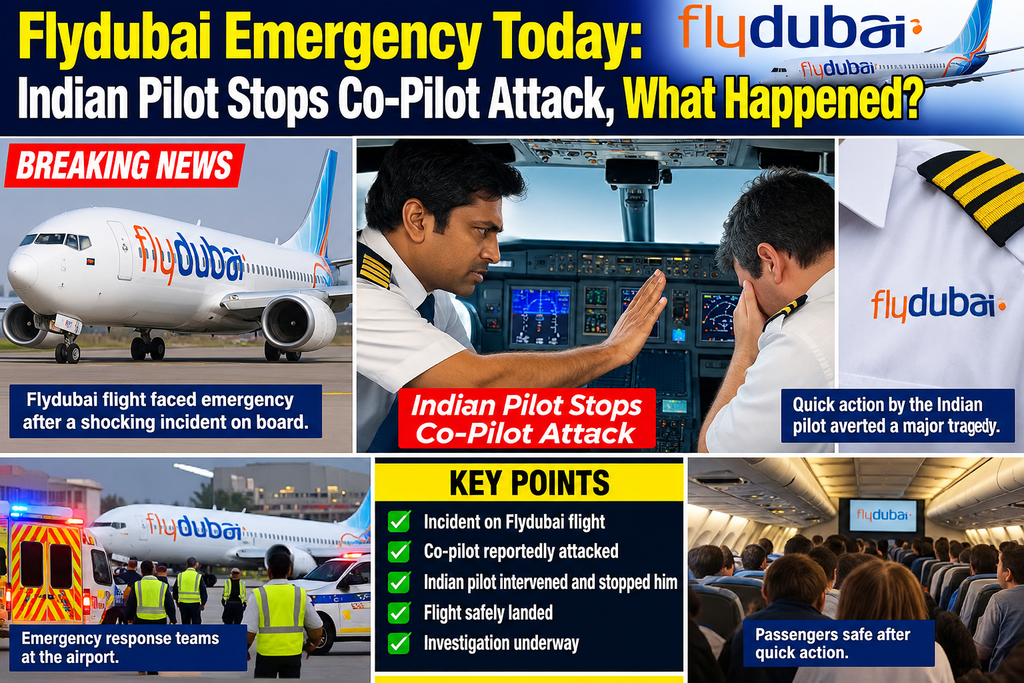
In one of the most dramatic mid-air crises in recent commercial aviation history, an Indian pilot fought back after being stabbed by his co-pilot aboard a Flydubai flight from Dubai to Tel Aviv on Wednesday, September 30, 2026, helping prevent what Israeli officials described as an apparent attempt to crash the aircraft. The Boeing 737 carrying approximately 174 passengers, including 27 children, plunged nearly 14,000 feet in under 30 seconds before passengers, crew, and off-duty pilots intervened, leading to a safe emergency landing in Tabuk, northwestern Saudi Arabia.
The pilot in command, Captain Smit Machchhar, an Indian national from Mumbai and former SpiceJet pilot, has been widely hailed as a hero for his actions despite sustaining serious injuries. Israeli Prime Minister Benjamin Netanyahu publicly praised Machchhar’s “extraordinary bravery,” stating that the wounded captain fought back, resisted, opened the cockpit door, and enabled passengers and crew to overpower the attacker, thereby saving the lives of everyone on board.
The Flight and the Sudden Crisis
Flydubai Flight FZ1073 departed Dubai International Airport around 6:49 a.m. local time on Wednesday, bound for Ben Gurion Airport in Tel Aviv. The roughly three-hour-and-15-minute journey was routine until the aircraft was approaching Israeli airspace, roughly two to two-and-a-half hours into the flight. At cruising altitude near 33,000–34,000 feet, a violent confrontation erupted inside the locked cockpit.
According to accounts from Israeli officials, including Netanyahu, the co-pilot—an Omani national—stabbed Captain Machchhar and attempted to take control of the aircraft with the apparent intention of crashing it. Flight-tracking data showed the plane entering a rapid, uncontrolled descent, losing approximately 14,000 feet (around 4,267 meters) in less than 30 seconds, and in some reports dropping from about 33,000 feet to around 17,000–19,000 feet within roughly a minute. Passengers later described the sensation as extreme turbulence or a sudden free-fall, with objects and people thrown about the cabin.
The aircraft transmitted emergency transponder codes, first the general emergency code 7700 and then 7500, the internationally recognised signal for unlawful interference or hijacking. These alerts prompted Israel to scramble fighter jets amid initial fears of a full hijacking. The plane briefly crossed into Jordanian airspace before returning to Saudi airspace and diverting toward Tabuk.
The Captain’s Critical Actions
Captain Smit Machchhar, who joined Flydubai as a direct-entry captain in June 2022 after more than 11 years with SpiceJet (where he served as a senior commander and line training captain), has extensive experience on Boeing 737 aircraft, with reports citing over 9,500 total flying hours, including more than 6,400 as pilot-in-command. Despite being stabbed—reportedly multiple times in the upper body and neck—and bleeding heavily while lying on the cockpit floor, Machchhar managed to unlock and open the reinforced cockpit door.
Israeli officials described this as drawing on the “last moments of his energy.” The door’s opening proved decisive. Reinforced cockpit doors, a post-9/11 security measure designed primarily to prevent external breaches, offered no protection against an internal attack by one pilot on another. By releasing the door, Machchhar allowed passengers and cabin crew to enter and confront the attacker.
Passengers and Crew Intervene
Passengers, many of them Israeli, reacted quickly once the door opened. Several accounts credit Israeli passengers, including Yaniv Hayun (also referred to in some reports in connection with the intervention) and Zvika Meness (or Manes), along with crew members, with storming the cockpit. They found the bloodied captain on the floor and the co-pilot at or near the controls, reportedly attempting to interfere with the aircraft’s systems.
Witnesses described a chaotic struggle lasting 20–30 minutes in some accounts. Passengers restrained the co-pilot using available items such as zip ties and headphone cords. One passenger recounted: “We tied him up with our zip ties and headphones.” Video footage verified by media outlets later showed bloodied figures on the cockpit floor and passengers asserting control. Off-duty Flydubai pilots travelling as passengers (sometimes described as relief pilots) then entered the cockpit, helped stabilise the aircraft, and took over the flight controls.
Flydubai confirmed in a statement that there had been an “altercation” in the cockpit, that on-duty crew travelling on the flight secured the aircraft, and that it diverted and landed safely at Tabuk Airport (TUU). The airline emphasised that all passengers and crew were safe and accounted for, while urging against premature speculation about the motive, which remained under investigation.
Aftermath and Official Responses
The aircraft landed safely in Tabuk. Both pilots were taken to hospital. Captain Machchhar was reported in stable condition; the Indian Embassy in Riyadh confirmed he was receiving medical treatment there and that officials were in contact with his family and Saudi authorities. The co-pilot was arrested by Saudi authorities and is undergoing interrogation.
A second Flydubai aircraft was later dispatched to retrieve the passengers and continue them to Israel. Upon arrival in Israel, survivors described the ordeal as a “miracle.” One passenger, Lital Shachaf, said: “It was awful, crazy, and we thank God that we survived it… We are back home.” Others spoke of initial panic turning to relief once control was restored.
Israeli Prime Minister Benjamin Netanyahu addressed the nation, calling the incident extremely serious and praising both Machchhar and the intervening passengers. He specifically highlighted the role of an Israeli passenger who helped break into the cockpit. Netanyahu noted that it was too early to determine any external links, including possible involvement by Iran, though investigations were continuing. Israeli officials have treated the event as a potential terror-related attempt while distinguishing it from a conventional passenger hijacking.
In India, Prime Minister Narendra Modi praised Captain Machchhar as a “hero.” Indian media and officials highlighted his background and composure under extreme pressure. The incident has drawn global attention to aviation security protocols, particularly the vulnerability when the threat originates from within the flight deck itself—an issue previously highlighted in rare historical cases.
What Remains Unknown
As of October 1, 2026, key details remain under active investigation by Saudi, Israeli, and possibly other authorities. The precise motive of the co-pilot has not been publicly established. Flydubai has stressed that the underlying reasons are unknown. Questions persist about pre-flight security screening for crew on sensitive routes, the co-pilot’s background and any dual nationality considerations, and how the knife was available in the cockpit. Some early reports raised the possibility of a deliberate crash attempt akin to past aviation disasters, but officials have cautioned against premature conclusions.
The presence of off-duty pilots on the specific flight has been described by some observers as a critical stroke of fortune that enabled a professional recovery of the aircraft after the immediate physical threat was neutralised.
Broader Context
Commercial aviation has seen relatively few successful internal cockpit attacks in the modern era, thanks in part to enhanced psychological screening, two-person rules in some jurisdictions, and reinforced doors. This incident, however, underscores that no system is foolproof when the attacker is already authorised inside the flight deck. The successful resolution—through the captain’s resilience, passenger courage, and the availability of qualified relief crew—averted what could have been a catastrophic loss of life.
Captain Smit Machchhar’s actions, performed while seriously wounded, stand at the centre of the story. By unlocking the cockpit door at a critical moment, he transformed a potential mid-air disaster into a survivable emergency. Passengers who physically subdued the attacker and the off-duty pilots who landed the plane have also been recognised for their decisive interventions.
Investigations continue in Saudi Arabia and Israel. For the 174 people who boarded FZ1073 expecting a routine flight, the events of September 30 will remain a stark reminder of both human vulnerability and extraordinary courage at 34,000 feet. All passengers and crew are reported safe. Captain Machchhar continues to recover under medical care in Tabuk.