

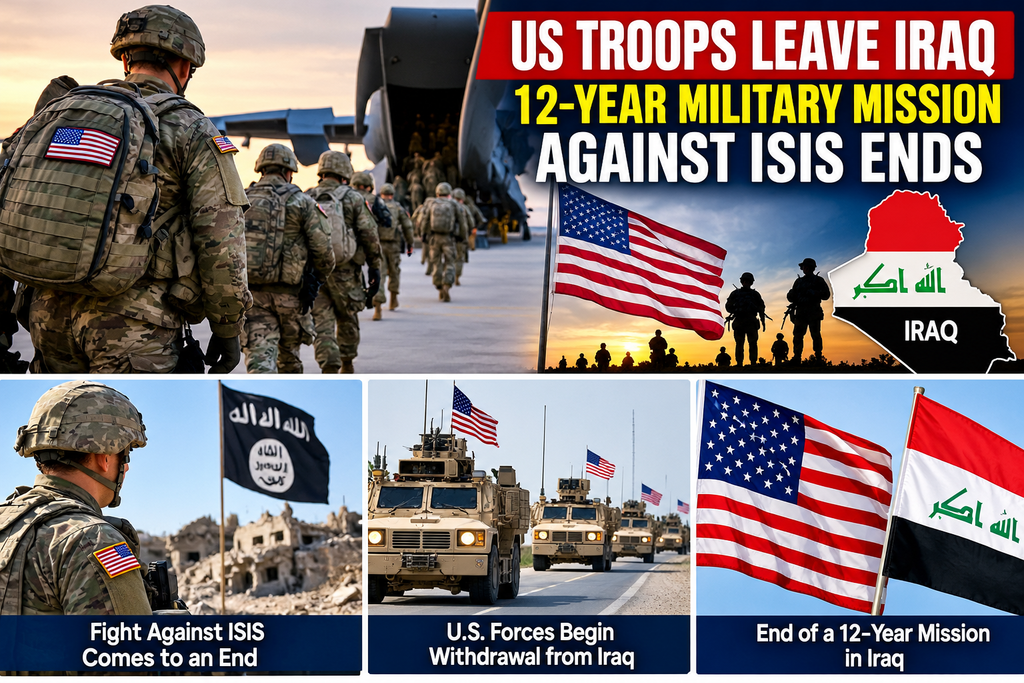
BAGHDAD / WASHINGTON — The United States announced on September 30, 2026, that it had completed the full withdrawal of its remaining forces and equipment from Iraq, formally concluding the Iraq portion of Operation Inherent Resolve, the 12-year military campaign against the Islamic State (ISIS). The final departure took place from Erbil Air Base in the semi-autonomous Kurdistan Region, marking the end of a continuous American military presence that began with the 2003 invasion to topple Saddam Hussein and later shifted to advising and assisting Iraqi forces against the jihadist group.
Pentagon spokesman Sean Parnell described the move as an “orderly departure” that reflected “the success of a 12-year campaign that defeated ISIS as an organised military threat in Iraq and across the region.” He emphasised the transition “from a wartime coalition mission to an Iraqi-led security effort supported by a more normal bilateral security relationship.” U.S. Central Command (CENTCOM) confirmed that the last personnel and equipment had left Erbil, with Combined Joint Task Force-Operation Inherent Resolve relocating its headquarters to Jordan while continuing limited counter-ISIS operations in Syria.
Iraqi Prime Minister Ali al-Zaidi presided over a handover ceremony in Baghdad, designating the day “Sovereignty Day.” He praised the sacrifices of Iraqi security forces and the international coalition, stating that Iraq’s security apparatus now fully controlled the country’s territory. “After September 30, not a single foreign soldier will remain anywhere in Iraq,” an Iraqi military spokesperson affirmed, including the Kurdistan Region. Celebrations unfolded in Baghdad, with security forces displaying national flags and civilians marking what many viewed as a restoration of full sovereignty.
President Donald Trump hailed the development as a “great day for America” and “a victory for the United States, a victory for Iraq, and a decisive victory over ISIS.” He referred to the earlier Iraq War as a “quagmire” and “a very expensive excursion into Hell,” while claiming credit for the territorial defeat of the group during his first term. Trump stressed that his administration had refused to allow a temporary presence to become permanent.
Background of the Mission
The current chapter of U.S. involvement began in 2014. After the complete withdrawal of American combat forces in 2011 under President Barack Obama, ISIS exploited political instability, sectarian tensions, and a weakened Iraqi military to seize vast territory. In June 2014, the group captured Mosul, Iraq’s second-largest city, and declared a caliphate spanning parts of Iraq and Syria. At its peak, ISIS controlled roughly one-third of Iraqi territory and imposed a brutal rule marked by mass killings, enslavement of Yazidi women and girls, public executions, and the destruction of cultural heritage.
At the request of the Iraqi government, the United States launched airstrikes in August 2014 and deployed advisers. What began as a limited advisory and air-support mission expanded into Operation Inherent Resolve, a multinational coalition involving more than 80 countries. Peak U.S. troop numbers in Iraq during the anti-ISIS campaign reached several thousand, with roughly 2,500 remaining in an advise-and-assist role since late 2021. Coalition forces provided training, intelligence, logistical support, and precision airstrikes that enabled Iraqi and Kurdish Peshmerga forces to reclaim territory. Mosul was liberated in 2017 after a gruelling battle; the last significant territorial holdings in Iraq fell shortly thereafter. By official estimates, the campaign killed more than 80,000 ISIS fighters and liberated approximately 7.7 million people.
U.S. casualties during the anti-ISIS phase were comparatively limited—123 American service members killed and 499 wounded—contrasting with the much higher toll of the 2003–2011 period, which saw 3,481 U.S. troops killed in hostile action and hundreds more non-hostile deaths. Overall, American involvement in Iraq since 2003 cost trillions of dollars and reshaped the region’s geopolitics.
The Path to Withdrawal
The decision to end the coalition mission stemmed from a 2024 agreement between the Biden administration and Baghdad. With ISIS reduced to scattered sleeper cells and residual attack capability at its lowest levels in years, both sides agreed to phase out the multinational wartime framework. Most U.S. forces left bases in federal Iraq during 2025, consolidating the remaining contingent—several hundred to around 1,500 at times—in Erbil. The final September 30, 2026, deadline was reaffirmed under the Trump administration despite the outbreak of direct U.S.-Iran hostilities earlier in 2026.
Iran-backed militias, long opponents of the American presence, celebrated the departure as a victory achieved through sustained pressure, including rocket and drone attacks on U.S. positions in previous years. These groups, integrated into Iraq’s Popular Mobilisation Forces, have resisted full disarmament. The Iraqi government had initially linked the withdrawal timeline to militia disarmament, but that process has been delayed, with some deadlines pushed to mid-2027. Analysts note that the absence of U.S. forces removes a key justification militias used to retain independent arsenals while simultaneously raising concerns about their growing influence.
Regional and Security Implications
The withdrawal does not end all U.S. counter-ISIS efforts. Forces remain in Syria, and the task force headquarters in Jordan will continue monitoring the threat. The Pentagon pledged ongoing “targeted training and intelligence support” to Iraqi partners under a bilateral defence relationship. CENTCOM commander Admiral Brad Cooper stated that Iraqi security forces, including the Peshmerga, now possess the capacity to manage threats independently, while U.S. and coalition units in the region stand ready to respond if necessary.
Nevertheless, experts and local officials express caution. ISIS remnants persist in remote desert areas and as underground networks. Kurdish commanders have reported increased movement by sleeper cells in the weeks leading up to the withdrawal, warning that the loss of U.S. intelligence, drones, and rapid-response capabilities could allow the group limited breathing room. Iraqi security analysts have highlighted the risk of security vacuums in a country still navigating sectarian politics, economic challenges, and the competing influences of Iran and other regional actors.
The broader context includes the ongoing U.S.-Iran confrontation. Bases in the Kurdistan Region faced attacks after hostilities intensified in early 2026. Kurdish officials voiced particular concern about the removal of American air defences at a time of elevated regional tension. Iran and its proxies framed the U.S. exit as validation of their strategy of attrition, while some Iraqi voices worry that Tehran’s influence may expand in the absence of a balancing American military footprint.
Historical Perspective and Future Outlook
The American military presence in Iraq has spanned more than two decades and multiple administrations. The 2003 invasion toppled a dictatorship but unleashed sectarian civil war, the rise of al-Qaeda in Iraq (ISIS’s precursor), and years of insurgency. The 2011 withdrawal was followed by the catastrophic territorial gains of ISIS, prompting the 2014 return. Operation Inherent Resolve succeeded in dismantling the caliphate but left behind a fragile security architecture and unresolved questions about governance, corruption, and the integration of militia forces into the state.
Iraqi leaders now assert full responsibility for internal security. Prime Minister al-Zaidi has reiterated commitments to strengthen national institutions and continue the fight against residual terrorism. Whether Iraqi forces can sustain pressure on ISIS without the dense network of coalition intelligence and air support that characterised the past decade remains an open question. The shift to a “normal bilateral security relationship” envisions continued U.S. training, equipment sales, and intelligence sharing, but without permanent bases or combat troops.
For the United States, the withdrawal closes a costly chapter defined by strategic overreach, tactical adaptation, and eventual success against a territorial terrorist state. It also reflects a broader American desire, articulated across administrations, to reduce direct military entanglement in the Middle East while retaining the ability to respond to threats. Regional dynamics—particularly the U.S.-Iran rivalry, the status of Syrian operations, and the internal balance of power in Iraq—will determine whether the gains against ISIS endure.
As the last American aircraft departed Erbil and Iraqi flags flew over former coalition facilities, the moment carried both celebration and uncertainty. The organised military threat of ISIS has been defeated. The harder task of consolidating that victory under purely Iraqi leadership, amid complex regional pressures, now begins. The coming months and years will test whether the 12-year mission truly marked the end of one chapter or simply the transition to a more ambiguous and potentially more contested future for Iraq and its neighbours.