

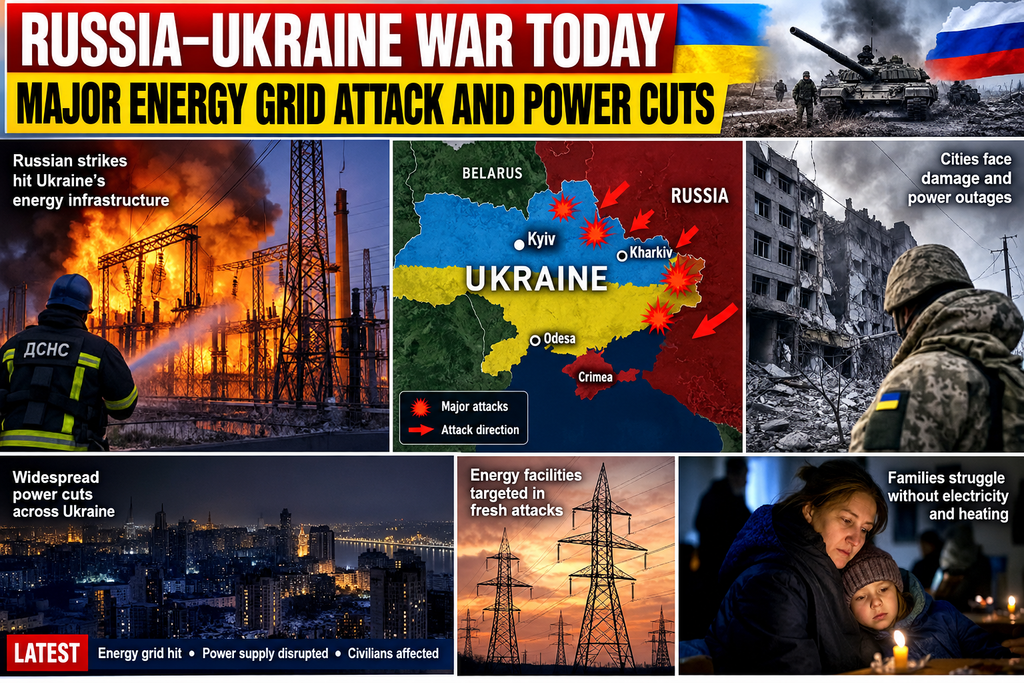
KYIV, October 1, 2026 — Russia launched its most intense combined drone and missile assault on Ukraine’s energy infrastructure in months overnight into Wednesday, striking power facilities primarily around Kyiv and across at least 10 other regions. The attacks killed seven people, including a child, and wounded dozens. They prompted Ukraine’s state grid operator to impose emergency power cuts in the capital and surrounding areas for the first time since spring.
Ukrainian officials described the strike package as the heaviest directed at energy sites since the end of the previous heating season. President Volodymyr Zelenskyy reported that Russian forces employed nearly 190 strike drones—many of them faster jet-powered models—alongside ballistic and cruise missiles. Ukraine’s Air Force said air defences intercepted or suppressed the bulk of the incoming threats, downing five ballistic missiles and approximately 155 drones, yet weapons still struck 18 locations.
Prime Minister Serhii Koretskyi stated that Russia had “escalated to massive strikes on energy infrastructure.” He noted that while energy facilities had faced near-daily attacks since summer, a combined assault of this scale had not occurred since the end of the last heating season. The main concentration of fire fell on Kyiv City and Kyiv Oblast energy assets. Russia’s Defence Ministry claimed successful hits on the Trypilska (Trypillia) thermal power plant—Kyiv’s largest electricity supplier—located roughly 40 kilometres south of the capital, as well as a hydroelectric facility, an electrical substation, an energy storage site, and a data centre. Ukrainian energy company Centrenergo confirmed damage to generating equipment at the Trypillia plant but withheld full details for security reasons.
The human toll included a child recovered from the rubble of a collapsed private home in the Kyiv region town of Vyshhorod. Nationwide casualties rose to seven dead and between 14 and 24 wounded, according to successive updates from Zelenskyy and regional officials. Residential buildings, social infrastructure, civilian enterprises, and rail lines were also hit across 11 regions. Debris was reported near a Western embassy in Kyiv, though further details were not immediately released.
Ukrenergo, the national grid operator, introduced emergency power restrictions in Kyiv and three neighbouring regions. DTEK, Ukraine’s largest private energy firm, reported that supply to roughly 8,000 households had been disrupted but was restored after “a difficult night.” Some areas in Kyiv, Dnipropetrovsk, Donetsk, Sumy, and Kharkiv regions continued to experience outages into Wednesday. Trams and trolleybuses halted in parts of the capital; water pressure was reduced. Thick smoke from the strikes mixed with morning fog, blanketing the city as residents emerged from shelters.
The assault follows days of intensified drone barrages focused on Kyiv and comes as temperatures begin their seasonal decline. Ukrainian authorities and independent analysts view it as the opening phase of Russia’s anticipated winter campaign aimed at degrading electricity generation and transmission capacity. The objective, repeated across previous winters, is to force prolonged blackouts, disrupt heating systems, and impose severe hardship on the civilian population in an effort to erode morale and pressure the government. Last winter’s attacks, conducted amid record low temperatures, left large parts of the country cycling through scheduled and emergency outages and forced widespread adaptation, including reliance on generators, shared heating points, and backup power for critical services.
Ukraine entered the current heating season with a known generation shortfall. Earlier assessments indicated a deficit of several gigawatts relative to peak winter demand after cumulative losses from previous campaigns. Nuclear plants remain central to the grid but are vulnerable to transmission-line strikes that can force them offline or into reduced output. Repair crews worked through the day to stabilise damaged facilities, yet officials warned that repeated large-scale attacks would compound the strain, particularly if air-defence stocks remain constrained.
Zelenskyy, who visited a command post near the eastern frontline town of Lyman, framed the strikes as part of a broader pattern of ballistic-missile and drone terror. He thanked partners for recent air-defence deliveries while emphasising the urgent need for additional systems as winter nears. “The closer we get to winter, the more of this protection we need,” he said. “We must do everything to ensure that Russia’s bet on ballistic missile and drone terror does not pay off.” Ukrainian forces have also continued long-range strikes against Russian energy and refining infrastructure in a reciprocal campaign that has reduced Moscow’s refining capacity, though the scale and precision of the two sides’ efforts differ markedly.
On the ground, the attack underscored the dual challenges facing Ukraine: defending a vast territory against increasingly sophisticated and numerous aerial threats while maintaining essential services. Jet-powered drones, harder for low-cost interceptors to engage, featured prominently in the latest wave. Russia has steadily increased production and deployment of such systems, exploiting gaps in Ukraine’s layered air defences. Spillover threats prompted neighbouring Poland and Romania to scramble aircraft, highlighting the regional dimension of the escalating aerial campaign.
The Institute for the Study of War assessed the September 29–30 strike as marking the formal start of Russia’s winter energy campaign, intended to degrade Ukraine’s energy security ahead of the 2026–2027 heating season and increase pressure toward a negotiated settlement on Moscow’s terms. Ukrainian monitoring channels have warned of a methodical approach: systematic targeting of generation and transmission nodes to isolate nuclear plants from the unified grid, sever external supplies to Kyiv, and cripple industrial capacity in the east.
Civilian preparedness measures are already underway. Authorities have urged residents to stockpile essentials, maintain backup lighting and heating options, and consider alternative communications such as Starlink terminals amid concurrent Russian efforts to disrupt data centres and internet service providers. Earlier strikes on Kyiv’s digital infrastructure temporarily affected tens of thousands of households and raised concerns about the resilience of banking, payment, and public-service networks during prolonged outages.
Economically, each major air-raid alert carries high costs. Ukrainian officials have estimated that prolonged warnings and resulting business interruptions can run into tens of millions of dollars per hour of disruption. Cumulative damage to fixed energy assets this year has been placed in the billions. Repair cycles are accelerating, yet the pace of destruction risks outstripping reconstruction capacity without sustained external support for both defensive systems and generation equipment.
Internationally, the strikes renew calls for accelerated delivery of air-defence interceptors, additional Patriot and other battery systems, and long-term industrial partnerships to expand Ukraine’s domestic production of interceptors and electronic-warfare tools. Western governments have previously condemned Russian attacks on civilian energy infrastructure as violations of international humanitarian law; similar statements are expected in response to the latest wave. Russia maintains that its strikes target facilities supporting Ukraine’s military effort and constitute legitimate responses to Ukrainian attacks on Russian territory.
As of Thursday, restoration work continued across affected regions. Ukrenergo and private operators reported gradual stabilisation of supply, though emergency restrictions remained in force in the capital area pending further assessment of residual damage and grid balance. Zelenskyy and military commanders simultaneously highlighted incremental territorial gains in the east, illustrating the multi-domain nature of the conflict: grinding positional fighting on the ground alongside a high-intensity contest for control of the skies and critical infrastructure.
The overnight assault serves as a stark reminder that, more than four and a half years into the full-scale invasion, energy infrastructure remains a central theatre. With winter approaching and air-defence inventories under pressure, the ability of Ukraine to absorb and recover from successive large-scale strikes will shape both the humanitarian situation and the strategic calculus of the coming months. Residents of Kyiv and other cities are once again preparing for the possibility of cold, dark nights, while repair crews, air-defence crews, and political leaders race to blunt the impact of what appears to be the opening salvo of another winter energy war.