

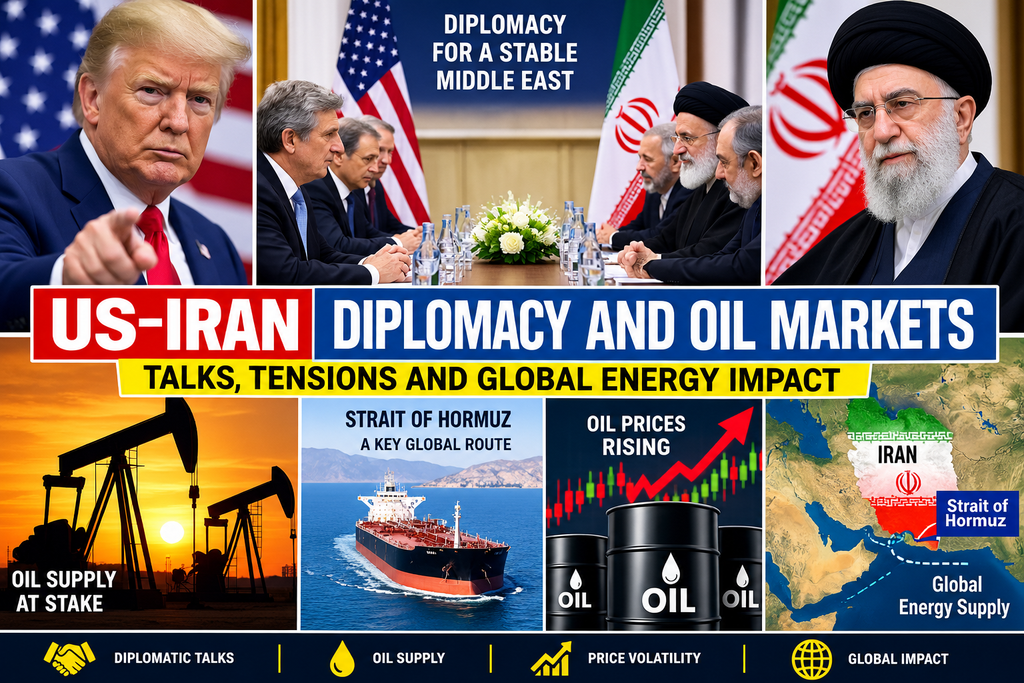
TEHRAN / NEW YORK / LONDON — Iranian officials confirmed on Wednesday that Tehran has received an official U.S. response to its latest proposal aimed at ending the seven-month conflict with the United States and its allies, though details of Washington’s reply remain undisclosed. The development comes amid a notable recovery in Gulf oil exports that has helped ease immediate supply concerns in global energy markets, with Brent crude trading near $96.92 a barrel in early sessions.
According to Iranian state media and government statements, Foreign Minister Abbas Araghchi presented the American response to President Masoud Pezeshkian during a Cabinet meeting. Government spokesperson Fatemeh Mohajerani told the official IRNA news agency that Araghchi briefed the Cabinet on the U.S. reply as well as on his recent activities at the United Nations General Assembly in New York. Pezeshkian responded by emphasizing Iran’s determination to pursue an agreement, stating that officials would “make every effort to bring the agreement to fruition and will firmly stand up for the rights of the Iranian people.” He added that any deal “must now be based on a win-win strategy.”
The officials did not disclose the content of the U.S. response or indicate whether it constituted an acceptance, a rejection, or a counterproposal. This follows public comments from U.S. President Donald Trump days earlier in which he rejected Tehran’s plan, arguing that Iran was seeking a deal because it was “losing so badly” and that the offer “would not be acceptable.” Despite the public rebuff, mediators continued private efforts to bridge differences. An official briefed on the talks, speaking anonymously, said Qatari intermediaries conveyed the U.S. position to Araghchi during a stopover in Doha as he returned from New York. The sides reportedly agree on many necessary steps but remain divided on sequencing.
Iran’s proposal, floated last week during indirect talks on the sidelines of the UN General Assembly, centered on a rapid reopening of the Strait of Hormuz. Araghchi had outlined conditions under which Iran would restore full maritime traffic through the vital waterway within seven days. These included the lifting of the U.S. naval blockade of Iranian ports, the release of frozen Iranian assets, the waiving of sanctions on Iranian oil sales, a broader ceasefire covering fronts including Lebanon, and progress toward resolving nuclear issues. Tehran frames the plan as a pathway to restore elements of an interim agreement signed earlier in the year by Trump and Pezeshkian that later collapsed.
The conflict, which began with U.S.-Israeli strikes on Iran in late February 2026, has entered its eighth month. It has severely disrupted shipping through the Strait of Hormuz, a chokepoint for a significant share of global oil and liquefied natural gas exports. U.S. forces have maintained a blockade of Iranian ports, while Iranian-aligned groups and other regional actors have conducted attacks that further complicated navigation and raised insurance costs. An earlier ceasefire framework reached in the spring and formalized in a June memorandum of understanding unraveled within weeks, leading to renewed hostilities and prolonged market uncertainty.
Indirect contacts between the two sides resumed in New York last week, the first proximity talks since the previous truce collapsed. Qatari and Pakistani mediators shuttled between U.S. and Iranian envoys. Araghchi used the opportunity to reiterate Iran’s conditions and meet with a range of international counterparts. Trump has publicly signaled openness to further engagement even while rejecting the specific Iranian proposal, at one point indicating that talks could resume and that a broader deal might follow the U.S. midterm elections. U.S. officials have stressed that any lasting arrangement must address Iran’s nuclear program, including highly enriched uranium stocks.
Parallel to the diplomatic developments, physical oil markets have shown signs of stabilisation driven by recovering export volumes from Gulf producers. Analysts at JPMorgan Chase and Goldman Sachs reported that Middle East oil flows have returned close to pre-war levels despite ongoing risks. JPMorgan estimated crude shipments rebounding to 17.5 million barrels a day, or about 98 per cent of pre-conflict volumes, while product flows such as diesel and gasoline lagged at roughly 58 per cent of earlier levels. Goldman Sachs put total Gulf oil exports, including so-called dark flows moved with transponders offline or via ship-to-ship transfers, at 23.3 million barrels a day in the most recent week—matching the 2025 average.
Saudi Arabia has played a central role in the recovery. The kingdom restored significant capacity on its East-West pipeline, which bypasses the Strait of Hormuz and feeds Red Sea terminals, reaching at least half of its potential after earlier damage. Flows through Hormuz itself have also increased, with some estimates placing crude crossings near late-June highs of nearly 13 million barrels a day at points, though overall security remains compromised. Producers and shippers have adapted by relying more heavily on alternative routes, shuttle tankers, and offshore transfers. Tracking data from firms such as Kpler indicated that non-Iranian Gulf crude exports returned to pre-war averages in September, with roughly 40 per cent of volumes now avoiding Hormuz entirely—up from about 17 per cent before the conflict.
These operational improvements have reduced the immediacy of supply-shortage fears that earlier pushed prices sharply higher. Brent crude, the international benchmark, traded around $96.92 a barrel in early sessions on October 1, reflecting a pullback from elevated levels seen in prior weeks when disruptions appeared more severe. Prices had fluctuated amid the war’s escalation, at times exceeding $100 and reaching higher peaks in September, but the rebound in physical flows has provided a counterweight. Market participants note that while crude volumes have largely recovered, refined product exports from the region remain constrained, and logistical inefficiencies continue to support elevated risk premiums.
Energy analysts caution that the recovery does not eliminate underlying vulnerabilities. The Strait of Hormuz remains a contested zone where attacks on vessels have been reported, including recent incidents monitored by British authorities. Insurance rates stay elevated, and any renewed escalation could quickly reverse the gains. Iranian oil exports themselves remain heavily restricted under the U.S. blockade, leaving a structural gap relative to full pre-war regional capacity. Chinese refiners and other major importers have adjusted intake levels in response to the prolonged disruption, helping to moderate the price impact of supply shortfalls.
The interplay between diplomacy and markets is particularly acute. A successful agreement that reopens the strait on stable terms and eases sanctions could unlock additional Iranian barrels and further normalise flows, potentially pressuring prices lower. Conversely, continued deadlock or a breakdown in talks risks renewed military action, which Trump has repeatedly threatened. Iranian leaders, including Supreme Leader figures and Pezeshkian, have insisted on sovereignty over Hormuz arrangements and broader regional ceasefires as non-negotiable elements, while rejecting what they characterise as demands for surrender.
International reactions have been measured. Mediators in Qatar continue to facilitate communication, describing efforts as aimed at building common ground. Other regional states, heavily dependent on energy revenues and concerned about spillover risks, have watched developments closely. The U.S. has simultaneously maintained economic pressure, with the Treasury Department announcing additional sanctions targeting networks accused of supporting Iran’s military supply chains under an “Operation Economic Outcast” campaign.
For oil markets, the near-term outlook hinges on whether the latest exchange of proposals produces tangible progress. Traders are monitoring both the substance of any follow-up communications and actual tanker movements through the Gulf. Inventories in major consuming regions have been drawn down during the conflict, leaving limited buffers against further shocks. At the same time, non-Gulf producers have increased output where possible, partially offsetting Middle Eastern shortfalls.
As Tehran reviews the U.S. response and Washington assesses Iranian reactions, the conflict’s economic dimension remains front and centre. Seven months of fighting have demonstrated both the resilience of adaptive export logistics and the fragility of the energy system when a critical chokepoint is contested. Whether the current diplomatic channel can turn a formal reply into durable de-escalation will determine not only the trajectory of hostilities but also the path of global oil prices in the months ahead.
The recovery in Gulf exports has bought time and reduced the most acute supply fears, allowing Brent to settle near the mid-$90s rather than remaining in triple-digit territory. Yet officials on both sides acknowledge that sequencing disagreements—over when sanctions lift, when the strait fully reopens, and how nuclear issues are handled—could still prolong the standoff. Pezeshkian’s call for a “win-win” framework and Trump’s insistence on terms favourable to U.S. and Israeli security interests encapsulate the core challenge.
In the coming days, attention will focus on any public or private signals from Tehran regarding the U.S. reply and on further data confirming the sustainability of higher export volumes. For now, the dual narrative of cautious diplomatic engagement and improving physical oil flows defines the moment: a conflict that has reshaped regional energy logistics continues, but markets have begun to price in a degree of operational normalisation even as political resolution remains elusive.