

October 2026
The Asia-Pacific region stands at a pivotal juncture in 2026. As the world’s economic and demographic centre of gravity, it continues to shape global prosperity while serving as the primary theatre for strategic competition between the United States and China. Two years into the second Trump administration and well into Xi Jinping’s third term, the region faces a landscape defined by managed rivalry rather than outright confrontation, yet one laced with escalating grey-zone pressures, nuclear modernisation risks, and fraying economic interdependence. Flashpoints from the Taiwan Strait to the South China Sea and the Korean Peninsula remain live, while middle powers assert greater agency through minilateral frameworks and hedging strategies. This report examines the emerging risks, intensifying rivalries, and policy priorities that will define the strategic environment through the remainder of the decade.
The Enduring Centrality of US-China Competition
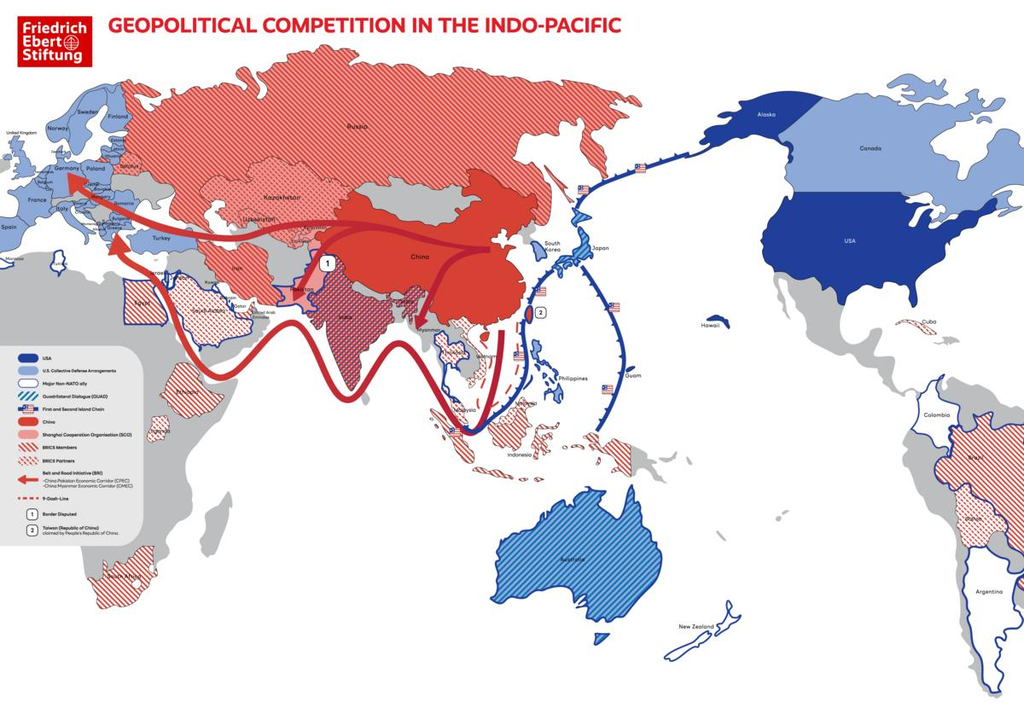
At the heart of the 2026 Asia-Pacific strategic outlook lies the structural competition between Washington and Beijing. Institutions such as the Centre for a New American Security and the International Institute for Strategic Studies describe the Indo-Pacific as the central arena in which the two powers contest the rules and balance of the 21st century. Economic entanglement persists, but it has been weaponised. Tariffs, export controls on advanced semiconductors and rare earths, and reciprocal investment restrictions have become normalised instruments of statecraft. A series of Trump-Xi engagements, including summits that produced language around “strategic stability,” “mutual respect,” and limited trade truces, have introduced tactical stabilisation. Yet these measures have not altered underlying trajectories. Beijing continues to prioritise military modernisation and expanding its regional influence, while Washington emphasises denial capabilities along the first island chain and burden-sharing among allies.
China’s People’s Liberation Army has sustained high levels of activity across multiple domains. Naval expansion, including additional nuclear-powered and nuclear-armed submarines, has altered the regional balance according to Australian and US assessments. At the same time, domestic fiscal pressures and leadership purges within the PLA have tempered expectations of an imminent large-scale invasion of Taiwan by the often-cited 2027 window. Instead, Beijing appears to favour persistent pressure and institutionalised grey-zone operations. For the United States, the second Trump administration has recalibrated priorities, placing greater emphasis on the Western Hemisphere and selective engagement in the Indo-Pacific. This has introduced uncertainty among allies regarding the durability of American security guarantees, even as operational cooperation in exercises, intelligence sharing, and force posture adjustments continues.
Middle powers and regional states have responded by diversifying partnerships rather than choosing sides. Economic interdependence among China, Japan, and South Korea continues to act as a stabilising force, yet militarisation of the East China Sea and competition over resources have eroded some of that buffer. The result is a more fragmented order in which multi-aligned countries seek strategic autonomy while great-power rivalry sets the overarching parameters.
Taiwan Strait: The Quarantine Window and Grey-Zone Escalation
Taiwan remains the most consequential flashpoint. Chinese pressure has shifted from large-scale amphibious invasion rehearsals toward sustained maritime and air operations designed to normalise presence and test thresholds. Coast guard and research vessel activity east of Taiwan increased markedly through mid-2026, with continuous rotating patrols established. Independent assessments describe these operations as the operational testing of an asymmetric quarantine or siege mechanism that could disrupt energy imports and semiconductor production without crossing into open warfare. Taiwan’s heavy dependence on seaborne energy and the outsized electricity demand of its semiconductor industry render it particularly vulnerable to prolonged maritime interdiction.
US arms packages for Taiwan, including significant air defence systems, have faced delays and political bargaining, heightening perceptions of uncertainty in Taipei. Chinese messaging has linked Taiwan to the broader US-China relationship, with public statements underscoring the risk of collision if the issue is mishandled. On the island itself, domestic political polarisation and energy policy debates—following the closure of the last nuclear reactor—compound strategic vulnerability. Most analysts assess that a full-scale invasion remains unlikely in the near term, but the probability of a customs-quarantine declaration or intensified grey-zone campaign has risen. Such a scenario would challenge alliance response mechanisms and risk rapid escalation through miscalculation.
South China Sea and Maritime Contestation
In the South China Sea, Chinese reclamation and militarisation activities have resumed in key areas, while confrontations with the Philippines have intensified. Multiple incidents in a single week at Scarborough Shoal and Second Thomas Shoal in mid-2026 prompted joint maritime drills involving the United States, the Philippines, and Japan. Beijing’s expansive claims, rejected by the 2016 arbitral ruling, continue to drive grey-zone tactics involving coast guard vessels, maritime militia, and water-cannon confrontations. These actions test the resolve of claimant states and the credibility of mutual defence commitments.
The Philippines has responded by deepening cooperation with ASEAN partners, India, and traditional allies, while other claimants such as Vietnam and Malaysia pursue more cautious diplomatic and capacity-building approaches. Control of sea lanes and resources remains central. The strategic geography of the region—particularly chokepoints such as the Malacca, Luzon, and Taiwan straits—means that disruptions would reverberate through global energy and trade flows. China’s growing presence in the Indian Ocean, including expanded access arrangements and the Djibouti base, further complicates the picture, raising operational proximity with India and other regional navies.
Northeast Asia: Korea, Japan, and Nuclear Risks
On the Korean Peninsula, North Korea has leveraged its partnership with Russia to advance missile capabilities and has formally abandoned peaceful reunification as a long-term goal, designating the South as a mortal enemy. This hardening of posture, combined with continued nuclear and missile development, elevates the risk of miscalculation. South Korea and Japan have responded by consolidating alliances with the United States and expanding their own defence capabilities. Japan, under Prime Minister Sanae Takaichi, has accelerated defence modernisation, strengthened the US-Japan alliance, and deepened security cooperation with Australia and other partners. Tokyo views itself as a critical node in containing Chinese influence within the first island chain and has moved to enhance long-range strike options and joint operational concepts.
Nuclear risks across the Asia-Pacific have risen. Regional states and external powers are expanding arsenals or pursuing long-range conventional strike capabilities that compress decision timelines. The integration of artificial intelligence, cyber tools, hypersonics, and space systems into military doctrines introduces new pathways for inadvertent escalation. Assessments highlight the danger of “sleepwalking into instability” as nuclear modernisation proceeds without corresponding arms control or risk-reduction mechanisms tailored to the region’s multipolar dynamics.
South Asia, the Indian Ocean, and Broader Rivalries
India continues its dual focus on China and Pakistan. Border tensions with China persist, while relations with Pakistan remain volatile following renewed military confrontations after militant attacks. India’s doctrine emphasises proactive responses, including surgical strikes, and its military modernisation prioritises large-scale conventional operations. In the Indian Ocean, competition over maritime chokepoints and undersea infrastructure has intensified. China’s expanding logistical footprint drives closer intelligence-sharing and joint exercises among India, Australia, and others. ASEAN faces internal challenges, including ongoing instability in Myanmar and border frictions such as those between Thailand and Cambodia, testing the organisation’s coherence and centrality.
Minilateral Architectures Under Pressure and Adaptation
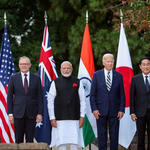
The Quad (Australia, India, Japan, United States) and AUKUS have remained operational but face questions about political prioritisation under the second Trump administration. Quad foreign ministers’ meetings in 2026 reaffirmed commitment to a Free and Open Indo-Pacific and launched concrete initiatives on maritime domain awareness, critical minerals frameworks, energy security, and technology cooperation. Cooperation with ASEAN has been emphasised to uphold ASEAN centrality. AUKUS continues to advance nuclear-powered submarine capability for Australia and Pillar II technology sharing, while Japan-Australia defence industrial ties—including frigate acquisitions and joint projects—have deepened, effectively linking non-AUKUS partners into advanced technology ecosystems.
Trilateral cooperation among the United States, Japan, and South Korea has progressed on issues such as quantum security and missile defence, even as political trust in American commitments fluctuates. Regional states increasingly pursue networked security architectures that do not require formal alliances, emphasising practical deliverables in maritime surveillance, supply-chain resilience, and critical technologies.
Cross-Cutting Risks: Technology, Supply Chains, Climate, and Infrastructure
Beyond traditional flashpoints, several cross-cutting risks are reshaping the strategic environment. Technological competition in artificial intelligence, quantum computing, semiconductors, and undersea cables creates both opportunities and vulnerabilities. Subsea cables, which carry the vast majority of global data and financial transactions, represent critical chokepoints susceptible to sabotage or disruption. Critical minerals and rare earths have become instruments of leverage, with China’s export controls demonstrating the ability to disrupt downstream manufacturing. Supply-chain diversification toward Southeast Asia and trusted partners continues, yet complete decoupling remains impractical given residual economic interdependence.
Climate and extreme weather risks compound strategic challenges by stressing infrastructure, energy systems, and disaster-response capacity. Military doctrines increasingly incorporate these environmental factors, while regional cooperation on humanitarian assistance and disaster relief offers limited avenues for functional collaboration amid rivalry. Generative AI-enabled disinformation and cyber threats further erode societal resilience and complicate crisis management.
Policy Priorities for Key Actors
For the United States, priorities centre on sustaining a favourable balance of power through denial strategies, alliance burden-sharing, and selective economic measures, while managing the risk of crisis escalation over Taiwan. Allies seek clearer signalling on security commitments alongside continued operational cooperation. Japan prioritises defence capability enhancement, economic security (critical minerals, supply chains, energy), and deepening minilateral ties to hedge against fluctuations in US engagement. Australia focuses on AUKUS delivery, northern force posture, and Pacific Islands engagement to counter Chinese influence. India emphasises strategic autonomy, dual-front readiness against China and Pakistan, and Quad deliverables that advance maritime and technological interests without compromising multi-alignment.
ASEAN members prioritise centrality, internal coherence, and hedging through diversified partnerships. Claimant states in the South China Sea seek capacity-building support and legal reinforcement of maritime rights. Taiwan’s priorities revolve around resilience—energy security, civil defence, and asymmetric capabilities—while navigating political uncertainty in Washington. China continues to pursue military modernisation, grey-zone pressure, and the hollowing out of countervailing coalitions, while managing domestic economic challenges and avoiding uncontrolled escalation.
Across the region, shared priorities include strengthening maritime domain awareness and real-time information sharing; building resilient critical mineral and technology supply chains; investing in undersea cable protection and redundancy; advancing risk-reduction mechanisms for nuclear and conventional forces; and enhancing societal resilience against hybrid threats. Practical cooperation on climate adaptation and disaster response can provide limited stabilising ballast.
Outlook: Managed Rivalry with Persistent Flashpoint Risk
Looking ahead through 2026 and into 2027, the baseline trajectory is one of intense but managed US-China competition, punctuated by grey-zone incidents and periodic diplomatic stabilisation. The risk of major war remains contained by mutual economic interests, nuclear deterrence, and the high costs of conflict, yet the probability of miscalculation or controlled escalation over Taiwan, the South China Sea, or the Korean Peninsula is elevated. China’s institutionalisation of maritime pressure tactics, combined with alliance uncertainties and technological compression of decision timelines, creates a more brittle environment than in previous years.
Regional actors will continue to expand agency through minilateralism, capacity-building, and multi-alignment. Success will depend on translating political commitments into operational interoperability, resilient economic architectures, and credible deterrence without unnecessary provocation. The Asia-Pacific’s future prosperity and stability hinge on whether great-power rivalry can be channelled into competition rather than confrontation, and whether middle powers can sustain the space for strategic autonomy. In an era of strategic reordering, vigilance, resilience, and pragmatic cooperation remain the essential policy imperatives.