
St. Petersburg, Russia — October 21, 2026
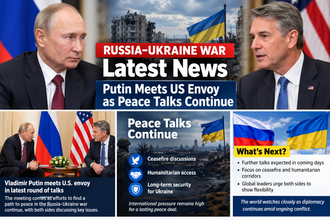
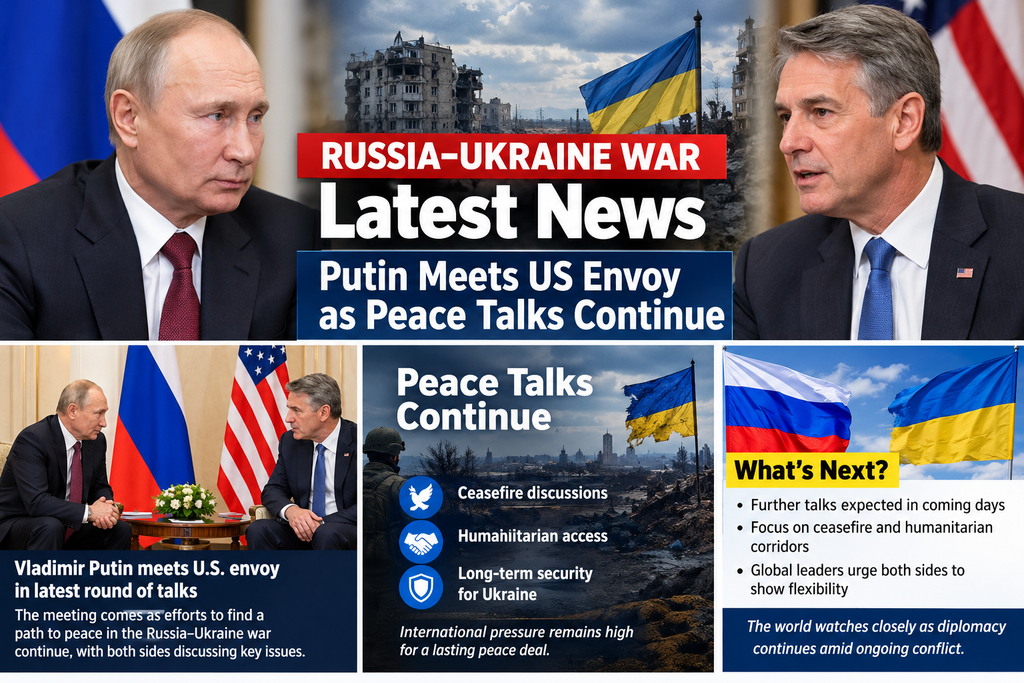
In a high-stakes diplomatic encounter that underscored the shifting dynamics of the nearly five-year Russia-Ukraine conflict, Russian President Vladimir Putin hosted US Special Envoy Steve Witkoff at the ornate Constantine Palace in St. Petersburg on Wednesday for nearly three hours of talks aimed at advancing proposals to end Europe’s deadliest war since World War II. The meeting, the ninth face-to-face engagement between Witkoff and Putin, produced signals of renewed momentum toward trilateral negotiations involving Russia, Ukraine, and the United States, alongside a notable goodwill gesture: the unilateral release of a long-detained American citizen.
The discussions came one day after Witkoff held what US officials described as “constructive” and “productive” talks in Oslo with Ukrainian President Volodymyr Zelenskyy, Norwegian Prime Minister Jonas Gahr Støre, Finnish President Alexander Stubb, and representatives from the European Union, NATO, France, the United Kingdom, Germany, and Poland. Those Oslo sessions focused on key elements of a potential comprehensive peace framework, including security guarantees for Ukraine, postwar economic reconstruction and prosperity plans, and a broader European security architecture. US officials reported “meaningful progress” and “strong alignment at the working level” on further steps, with Ukraine presenting new ideas and proposals.
Witkoff arrived in St. Petersburg on Wednesday morning and was greeted at Pulkovo Airport by Kirill Dmitriev, Putin’s special presidential representative for investment and economic cooperation and CEO of the Russian Direct Investment Fund. Jared Kushner, US President Donald Trump’s son-in-law and a key figure in the administration’s diplomatic efforts, joined the St. Petersburg meeting remotely via video link after falling ill and being unable to travel. The opening portion of the talks was open to the press, after which the discussions continued behind closed doors.
Goodwill Gesture and Opening Remarks
The meeting began with a significant humanitarian development. Putin ordered the release of Stephen Hubbard, a 74-year-old retired American schoolteacher who had been detained in Russia for more than four years on charges of mercenary activity related to fighting for Ukrainian forces—charges Hubbard has denied. Hubbard had been sentenced to nearly seven years in prison. Putin informed Witkoff that Hubbard was already at the airport awaiting departure back to the United States with the US envoy. Trump later stated that Putin had agreed to free Hubbard with “no ‘swap’ necessary,” linking the release in part to recent US decisions to prevent new sanctions against Moscow from taking effect. Witkoff publicly praised Putin during the open session, calling him a “humanitarian” in response to the Russian leader’s prior comments about Trump.
In the televised opening, Witkoff expressed optimism about the process. “I think there’s some degree of momentum, and I hope that this today can be another step forward in the peace process and discussing how we resolve the Ukrainian conflict,” he said. He thanked Putin for Russia’s agreement to a recent “diesel deal” that lifted restrictions on Russian diesel exports, a move the Trump administration has said would help lower prices for American farmers and truckers. Witkoff indicated he had brought documents outlining ideas for a potential peace settlement for Putin to review at his leisure and specifically urged consideration of resuming trilateral talks between Ukraine, Russia, and the United States, including technical working groups.
Putin, for his part, welcomed Witkoff to his hometown of St. Petersburg and expressed interest in hearing the outcomes of the Oslo meetings. The Russian president also voiced interest in restoring economic cooperation with the United States and raised the possibility of a meeting involving China to discuss the Ukraine situation. Putin further offered Russian assistance in addressing issues related to Iran, citing Moscow’s long-standing relationship with Tehran and its potential to help manage concerns over Iran’s nuclear program. Discussions also touched on the implementation of an October 9 agreement between Putin and Trump concerning Russian diesel supplies to US and global markets, as well as potential Russian fertilizer exports.
Signals on Resuming Trilateral Talks
The most concrete outcome emerged in post-meeting briefings by Putin’s foreign policy aide Yury (Yuri) Ushakov. Ushakov told reporters that Putin informed Witkoff that Russia was “in principle” or “generally ready” to resume trilateral negotiations with the United States and Ukraine after November 10. The proposed focus would be on “building a security system for Russia and Ukraine after the end of the conflict” or establishing a postwar “security framework” for both countries. Ushakov noted that Witkoff had briefed Putin on the Oslo talks, observing some “new approaches” and “new points” from the Europeans and Kyiv, though he characterized them as not containing “much that was useful in the context of resolving the Ukrainian crisis.”
No full trilateral talks of this nature have occurred since February 2026, when they were suspended. The Kremlin has previously blamed Ukrainian strikes on Russian territory for the disruption. Ushakov indicated that a possible venue for the November round could be Abu Dhabi. A US official later confirmed that a proposal for a technical-level trilateral meeting had been accepted by the Ukrainians in Oslo and by the Russians in St. Petersburg. Trump has indicated he would welcome Russia’s willingness to return to negotiations.
Despite these signals, significant obstacles remain. Russian officials emphasized before and after the meeting that Moscow’s core positions have not changed. Progress toward a negotiated resolution is described as “theoretically possible,” but only if Ukraine makes “necessary decisions.” Failure to do so, Kremlin voices warned, would leave Ukraine in a worse position. Putin continues to insist on demands that include full Russian control of the Donetsk region in eastern Ukraine and firm guarantees against Ukrainian membership in NATO—conditions Kyiv has consistently rejected. There are no public indications that Russia has softened its maximalist territorial or security demands.
Broader Context of the Diplomatic Push
The St. Petersburg meeting occurs against the backdrop of a war that began with Russia’s full-scale invasion of Ukraine in February 2022 and has now entered its fifth year. Casualties on both sides run into the hundreds of thousands, infrastructure across Ukraine has been devastated by repeated Russian strikes, and the conflict has reshaped European security, energy markets, and global food supplies. Trump, who campaigned on a promise to end the war “within 24 hours” upon taking office, has pursued an aggressive diplomatic track involving Witkoff and Kushner. The administration has at times strained relations with Kyiv, with reports of limited real-time intelligence sharing and other measures that have concerned Ukrainian and European officials. Trump has publicly urged Ukraine to pursue an agreement or face “a very bad thing,” while describing Russia’s recent conduct on certain issues as relatively cooperative.
The Oslo talks represented an effort to coordinate Western and Ukrainian positions more tightly before engaging Moscow. Topics reportedly included air defense, energy infrastructure (following an earlier reported understanding on restraining strikes on energy facilities), the possibility of a partial or full ceasefire, the status of occupied territories, and long-term security arrangements. Zelenskyy has repeatedly stressed the need for robust security guarantees and has pressed for the rapid resumption of direct talks. European leaders have sought to ensure that any settlement does not simply freeze the conflict on terms unfavorable to Ukraine or set dangerous precedents for the continent’s security order.
Economic dimensions featured prominently. Beyond the diesel arrangement, the presence of Dmitriev highlighted Moscow’s interest in potential investment and commercial ties with the United States. Putin’s references to economic cooperation and a possible trilateral leaders’ meeting involving China, Russia, and the United States—potentially on the sidelines of the Asia-Pacific Economic Cooperation summit in Shenzhen next month—suggest an effort to broaden the diplomatic canvas and leverage great-power dynamics.
Challenges and Skepticism
Analysts and officials on all sides remain cautious. Russia’s willingness to talk “in principle” after mid-November does not equate to acceptance of Ukrainian or Western red lines. Kyiv has long insisted that any peace must include the restoration of territorial integrity, accountability for war crimes, and credible deterrents against future aggression. Many in Europe worry that a rapid settlement under current battlefield conditions could reward aggression and leave Ukraine vulnerable. Conversely, the prolonged war has imposed heavy costs on Ukraine’s economy, demographics, and military capacity, while Russia has adapted to sanctions and sustained its war effort through domestic mobilization and external partnerships.
The release of Hubbard is viewed by some observers as a calculated diplomatic move timed to the US midterm election cycle and designed to demonstrate goodwill to the Trump administration. Previous prisoner releases and swaps have often been linked to broader negotiations, though this instance was presented as unilateral. Witkoff’s repeated engagements with Putin—now totaling nine in-person meetings—reflect a sustained US effort to keep channels open even as battlefield realities and maximalist positions persist.
What Comes Next
Witkoff was expected to return to Oslo later Wednesday to brief Norwegian officials on the Putin meeting. The coming weeks will test whether the “momentum” cited by the US envoy translates into concrete technical talks or further high-level engagements. The proposed mid-November trilateral session, if it materializes, would represent the first formal three-way negotiations in many months and could provide a forum to test the new proposals developed in Oslo against Russian counter-positions.
For now, the Constantine Palace meeting has kept diplomatic options alive at a moment when military attrition continues and political pressures mount in multiple capitals. Putin’s readiness “in principle” to resume talks, the release of an American detainee, and the exchange of documents and ideas mark incremental steps rather than a breakthrough. The core issues—territory, security guarantees, neutrality or NATO aspirations, reconstruction financing, and accountability—remain deeply contested. Whether the pathway Witkoff sought to create leads to substantive progress or further delay will depend on the willingness of all parties to move beyond declarative readiness toward the hard compromises required to end a war that has already exacted an enormous human and strategic toll.
As winter approaches and the conflict grinds on, the eyes of governments, markets, and populations affected by the war will remain fixed on whether these latest contacts can generate the political will necessary for a durable settlement. The St. Petersburg talks of October 21, 2026, have kept the conversation going; transforming conversation into cessation of hostilities remains the far more difficult task ahead.