
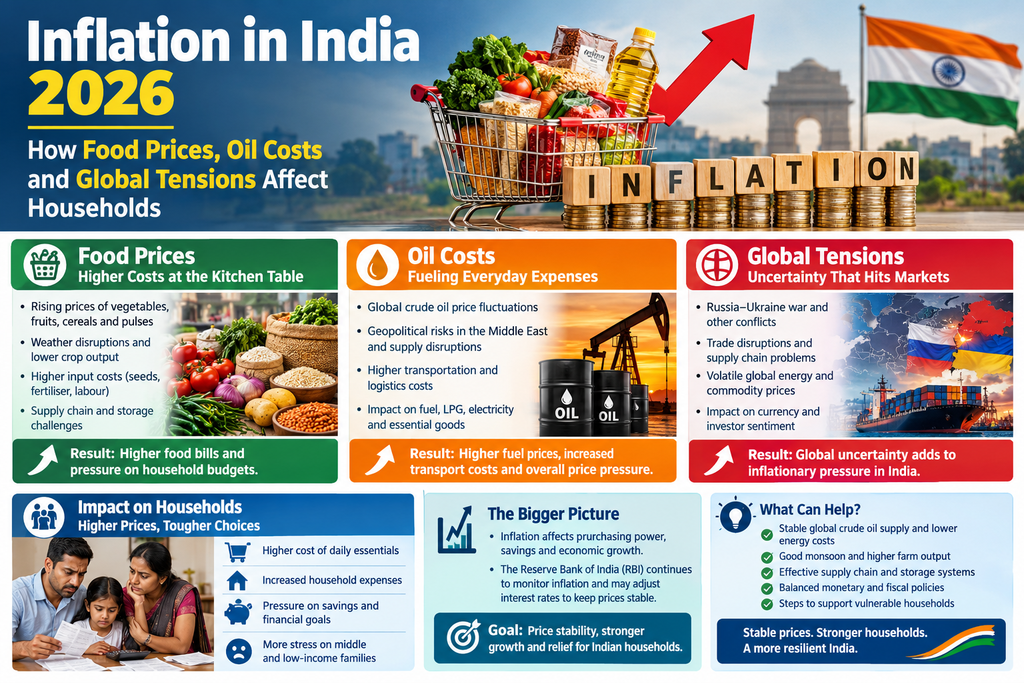
India’s retail inflation has climbed to its highest level in nearly two years, placing fresh pressure on household budgets already strained by volatile food costs and rising energy prices. Provisional data from the Ministry of Statistics and Programme Implementation show the Consumer Price Index (CPI) rose 5.54 per cent year-on-year in September 2026, up from 4.83 per cent in August. Food inflation, measured by the Consumer Food Price Index, accelerated more sharply to 7.74 per cent from 5.97 per cent. Rural households felt the impact more acutely, with overall CPI inflation at 6.08 per cent and food inflation at 8.06 per cent, compared with urban readings of 4.88 per cent and 7.18 per cent respectively.
The September figure marks the highest CPI inflation under the revised 2024=100 base series since October 2024 and the 11th consecutive month of rising price pressures. It sits near the upper end of the Reserve Bank of India’s 2–6 per cent tolerance band around its 4 per cent target. On 7 October, the Monetary Policy Committee raised the policy repo rate by 25 basis points to 5.50 per cent and shifted its stance from neutral to calibrated tightening. The central bank revised its full-year CPI forecast for 2026-27 upward to 5.2 per cent, with the third quarter projected at 6.0 per cent.
These numbers arrive against a backdrop of deficient and uneven southwest monsoon rainfall, strengthening El Niño conditions, and renewed geopolitical friction in West Asia that has pushed global crude oil prices higher. For ordinary Indian households, the combination of dearer vegetables, cooking oils, transport costs and the prospect of further monetary tightening is translating into tighter monthly budgets and difficult choices about spending on essentials versus discretionary items.
Latest inflation figures and the broader picture
The all-India CPI index stood at 109.49 in September 2026 (provisional), compared with 108.74 in August. Month-on-month, prices rose 0.69 per cent. Wholesale Price Index inflation remained elevated at around 11.4 per cent, reflecting cost pressures in primary articles, fuel and power, and manufactured products. Core inflation (excluding food and fuel) has also edged higher, signalling that price pressures are beginning to broaden beyond the most volatile categories.
Food and beverages, which carry a weight of roughly 37–42 per cent in the CPI basket depending on the rural-urban split, accounted for a large share of the headline rise. Within food, vegetables, sugar and confectionery, fruits and nuts, and oils and fats recorded the sharpest increases. Onion prices jumped more than 108 per cent year-on-year, the single largest contributor to food inflation. Ginger rose over 62 per cent, garlic more than 54 per cent, and lemon around 36 per cent. Sugar inflation exceeded 13 per cent, while refined oils and certain dairy products also firmed. In contrast, potato and tomato prices declined on a year-on-year basis, providing limited relief.
Personal care, social protection and miscellaneous goods and services recorded inflation near 14 per cent, while restaurants and accommodation services rose more than 9 per cent. Transport inflation stood around 5 per cent, reflecting the pass-through of higher fuel costs. Housing, water, electricity, gas and other fuels remained relatively moderate at under 3 per cent, as did health and education services.
The rural-urban divergence is significant. Food constitutes a larger share of rural consumption expenditure. Higher rural inflation therefore hits lower- and middle-income agricultural and labour households harder, reducing real purchasing power at a time when farm incomes are also sensitive to weather outcomes. Agricultural and rural labourers faced food inflation of 8.24 per cent and 7.84 per cent respectively in September.
Food prices and household expenses
For the typical Indian household, food remains the largest single budget item. When vegetable prices spike, the effect is immediate and visible in daily market visits. Onion, a staple across cuisines, has become a particular flashpoint. Tight supplies after lower rabi production, combined with weather disruptions and festival demand, drove the dramatic year-on-year increase. Similar dynamics affected other perishables.
Cooking oils, another essential, have been influenced by both domestic and international factors. Global vegetable oil prices have risen, and India’s heavy reliance on imports of palm, soybean and sunflower oil means international movements feed quickly into retail prices. Sugar prices have also firmed amid production concerns and stronger demand.
The cumulative impact on household budgets is material. Families report spending a larger share of income on the same basket of groceries. Lower-income households, for whom food can account for half or more of monthly expenditure, face the starkest trade-offs: reducing protein intake, cutting back on fruits and vegetables, or dipping into savings or credit. Middle-class urban households notice the pressure more in eating out, packaged foods and the overall grocery bill, while also contending with higher transport and service costs.
Government interventions—release of buffer stocks, open market sales, export restrictions on certain items when necessary, and subsidised distribution through the public distribution system—have helped moderate the extremes. Foodgrain stocks remain comfortable enough to provide a buffer. Yet perishable items such as onions and fresh vegetables are harder to stabilise through stocks alone, and distribution challenges can limit the reach of relief measures in some regions.
Seasonal factors compound the problem. The post-monsoon period and the approach of major festivals typically increase demand just as supply constraints from earlier weather disruptions become visible. El Niño risks raise concerns about the upcoming rabi season and water availability in key producing states.
International oil-price movements
Global crude oil prices have been a second major source of inflationary pressure. Brent crude futures have traded in the $112–117 per barrel range in recent sessions, with spikes above $117 amid reports of heightened tensions involving Iran and related security risks in the region. West Texas Intermediate has also risen sharply. Domestic crude oil futures on the Multi Commodity Exchange have tracked these gains, recently trading near ₹9,700–9,800 per barrel.
India imports close to 85–90 per cent of its crude oil requirements. A sustained rise in international prices therefore widens the import bill, puts pressure on the current account, and exerts downward pressure on the rupee. The currency has experienced bouts of weakness when oil spikes, even as the Reserve Bank has intervened to smooth excessive volatility. A weaker rupee in turn raises the landed cost of oil and other imported commodities, feeding into domestic inflation.
Retail petrol and diesel prices in India are influenced by international crude movements, exchange rates, and the tax and marketing margins of oil marketing companies. While pump prices have not always moved in lockstep with every daily fluctuation, the overall trend of higher crude has kept domestic fuel costs elevated compared with the lower-price environment of earlier periods. Higher diesel prices affect freight costs across the economy; higher petrol prices raise the cost of personal transport and two-wheeler commuting for millions of households.
The West Asia conflict, now in its later months, has kept a geopolitical risk premium embedded in oil prices. Even when physical flows through key chokepoints have largely recovered, market anxiety about potential further disruption sustains elevated levels. Analysts note that a durable de-escalation would be required to remove this premium and allow prices to settle lower.
Potential impact on transport and manufacturing
Higher oil and fuel costs feed directly into the transport sector. Freight rates for road transport, which dominates goods movement in India, rise with diesel prices. This increases the cost of moving agricultural produce from farm to market, industrial inputs, and finished consumer goods. Passenger transport—buses, taxis, auto-rickshaws and private vehicles—also becomes more expensive, raising the effective cost of commuting and travel for households and businesses.
In manufacturing, energy is a significant input cost for many industries. Petrochemicals, fertilisers, steel, cement, textiles and a range of intermediate goods feel the impact of higher fuel and feedstock prices. Power generation costs can also rise where liquid fuels or gas are used. These higher input costs are eventually passed through to wholesale and retail prices, contributing to the broadening of inflation beyond pure food and fuel categories.
The combination of elevated wholesale inflation and rising core inflation suggests that producers are beginning to recover higher costs. If this pass-through continues, it could sustain inflationary momentum even if food prices moderate later. For export-oriented manufacturers, higher domestic costs can erode competitiveness unless offset by productivity gains or favourable exchange-rate movements. For domestic market-focused firms, higher prices risk dampening demand, particularly among price-sensitive consumers.
Logistics and supply-chain costs also rise, affecting just-in-time manufacturing and the distribution of perishable goods. Small and medium enterprises, which often have less ability to hedge fuel costs or absorb margins, tend to feel the pressure more acutely than large corporates.
What consumers should monitor
Households can usefully track several indicators to anticipate and manage the impact on their budgets.
First, the monthly CPI and CFPI releases from the Ministry of Statistics remain the clearest official measure of retail price trends. The next CPI data for October is due in mid-November. Attention should focus not only on the headline number but on the food sub-index, rural-urban differentials, and the contribution of specific items such as vegetables, oils and cereals.
Second, global crude oil benchmarks—Brent and WTI—and the Indian basket price published by the Petroleum Planning and Analysis Cell provide early signals of fuel-cost pressure. Sharp or sustained moves above $110–115 per barrel raise the probability of further domestic fuel price adjustments or higher transport costs.
Third, monsoon progress, reservoir levels and sowing data for the rabi season will influence food-price expectations in the coming months. Weather forecasts and El Niño updates from meteorological agencies are therefore relevant.
Fourth, RBI monetary policy decisions and the accompanying inflation projections shape interest rates on loans, deposits and the overall cost of credit. The next MPC meeting is scheduled for early December. Further rate increases would raise EMIs on home, vehicle and personal loans, affecting household cash flows.
Fifth, government announcements on buffer-stock releases, export-import policy for essential commodities, and any temporary tax or subsidy measures can provide short-term relief or signals of policy priority.
Practical steps for households include prioritising essential spending, exploring bulk or cooperative purchases for staples where feasible, monitoring local market prices for seasonal produce, and reviewing discretionary outlays such as dining out or non-essential travel. Those with floating-rate loans should factor in the possibility of higher EMIs. Building or preserving a modest emergency buffer becomes more important when prices are volatile.
On the positive side, India’s economic growth has remained resilient, with strong activity indicators supporting employment and incomes in many sectors. Comfortable foodgrain stocks and the public distribution system continue to provide a safety net for vulnerable households. Policy measures aimed at improving agricultural productivity, storage infrastructure and supply-chain efficiency offer longer-term support for price stability.
Outlook and the balance of risks
The near-term inflation path remains challenging. The RBI’s projection of 6.0 per cent CPI inflation in the December quarter reflects expectations of continued food and energy pressure. Core inflation is also projected higher. Global oil prices will depend heavily on geopolitical developments in West Asia; a sustained de-escalation would ease one major risk factor, while further escalation could push prices and domestic inflation higher.
Weather remains another key uncertainty. A favourable rabi season and normal winter rainfall would help moderate vegetable and pulse prices in the months ahead. Conversely, further weather shocks would prolong food-price pressure.
For households, the combination of elevated food costs, higher transport expenses and the prospect of tighter monetary policy means that real disposable income growth may remain under pressure for some time. Careful budgeting, attention to official data releases, and awareness of policy responses can help families navigate the current environment. Policymakers, for their part, face the dual task of containing inflation without unduly dampening the growth momentum that has supported employment and incomes.
As of late October 2026, the data paint a clear picture: inflation has accelerated, food prices are the primary driver, oil and geopolitical risks add a second layer of pressure, and the effects are already visible in household budgets across rural and urban India. Monitoring the evolving numbers and policy responses will be essential in the months ahead.