
Washington / Beijing / New Delhi — October 2026
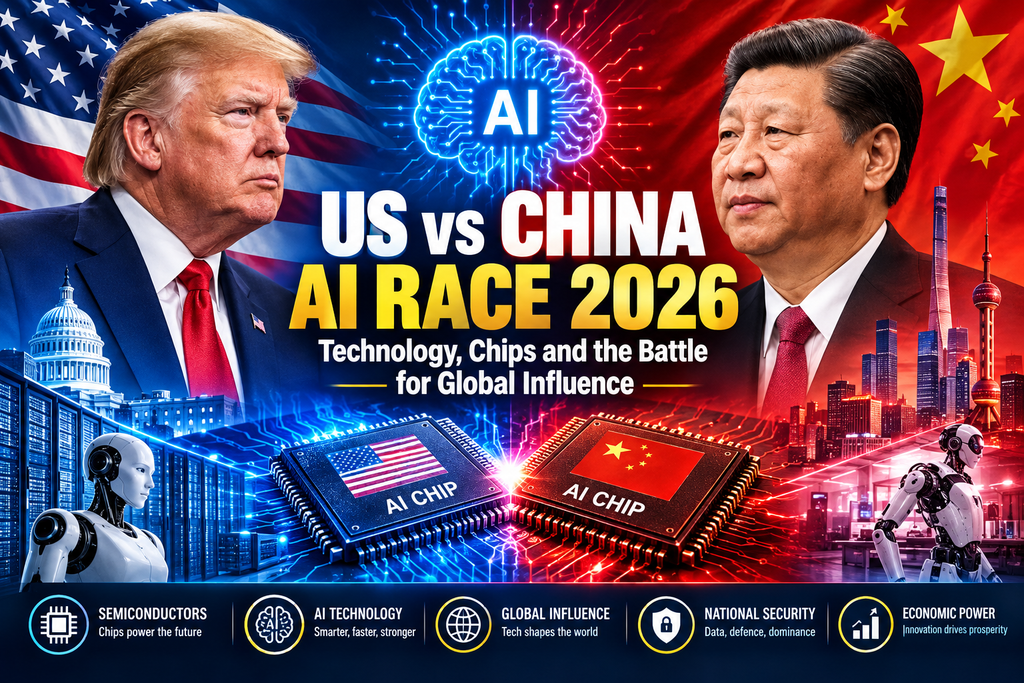
The contest between the United States and China for dominance in artificial intelligence has entered a sharper, more complex phase in 2026. What began as a race for the most capable frontier models has broadened into a struggle over advanced semiconductors, computing infrastructure, capital flows, open versus closed model ecosystems, and rival international partnerships. The gap in leading model performance has narrowed dramatically—to roughly six to six-and-a-half months by most independent estimates—while the underlying hardware and geopolitical architecture of the competition has hardened.
Former Google CEO Eric Schmidt has described the remaining difference as “negligible,” measured in “nanoseconds.” Independent analyses from the Institute for Progress, Epoch AI, Stanford’s AI Index, and others converge on a similar figure: the best American models still lead, but Chinese systems from DeepSeek, Moonshot (Kimi K3), Alibaba’s Qwen series and others now trail by half a year or less. In March 2026, the performance differential on key leaderboards stood at about 2.7 per cent. That narrowing has occurred despite sustained U.S. export controls on advanced chips and manufacturing equipment.
The race is no longer primarily about who produces the single most intelligent system in a laboratory. It is about who controls the supply of high-performance compute, who sets the standards and governance frameworks that the rest of the world adopts, and who captures the economic and strategic value that AI will generate across industry, defence, and society.
Latest Developments in the US–China AI Competition
Throughout 2025 and into 2026, Chinese laboratories demonstrated repeated ability to close capability gaps quickly. DeepSeek’s earlier models forced a re-evaluation of cost and efficiency. Moonshot’s Kimi K3, released in mid-2026, approached the performance of leading Anthropic and OpenAI systems at a fraction of the inference cost. Chinese open-weight models overtook American counterparts in cumulative downloads on platforms such as Hugging Face, reaching more than 1.15 billion by early 2026 against roughly 723 million for U.S. open models.
Two techniques have accelerated China’s progress. The first is distillation: Chinese teams query frontier Western models and use the outputs to train their own systems more efficiently. Analysts estimate this method alone recaptures roughly half of the theoretical lead that superior U.S. training compute would otherwise produce. The second is the aggressive release of open-weight models that can be freely downloaded, fine-tuned and deployed, particularly attractive in markets outside the wealthiest economies.
The United States retains clear advantages in absolute private investment and total AI computing capacity. U.S. private AI investment in 2025 reached approximately $286 billion—more than twenty times China’s comparable figure in some tallies. American hyperscalers (Amazon, Microsoft, Google, Meta, Oracle and others) are projected to spend more than $780 billion on capital expenditure in 2026, the bulk of it directed at AI infrastructure. China’s leading internet and telecom firms plan roughly one-tenth of that amount for data-centre spending in the same year.
Yet China leads in research volume and patents. It accounted for more than 27 per cent of global AI publications in recent tallies against about 12 per cent for the United States, and holds a large majority of granted AI patents. Chinese firms also dominate the open-model download charts, giving them outsized influence over the global developer community.
Diplomatic contact has not frozen the rivalry. In September 2026, as Presidents Trump and Xi met in Washington, U.S. and Chinese officials discussed establishing a formal AI dialogue and an incident-notification mechanism. Those talks produced limited concrete results on technology sharing or export-control relaxation. Both sides continue to treat AI as a core element of national power.
Advanced Chips and Computing Infrastructure
Semiconductors remain the decisive bottleneck. The United States and its allies control the most advanced logic processes, extreme-ultraviolet lithography tools, and the highest-performance AI accelerators, primarily from Nvidia. Export controls imposed and tightened since 2022 have restricted China’s access to the latest Nvidia GPUs and to the equipment needed to manufacture comparable chips at scale.
China has responded on multiple fronts. Huawei’s Ascend series has become the centrepiece of the domestic stack. Industry analysis suggests Chinese domestic production of AI chips will reach roughly one million H100-equivalents in 2026 and more thereafter, though yields and absolute performance still lag Nvidia’s leading products. Huawei has also pursued “group computing” architectures that cluster large numbers of processors with high-bandwidth optical interconnects to compensate for individual chip limitations. Other Chinese designers—Alibaba’s T-Head, Baidu’s Kunlun, Cambricon and others—are shipping increasing volumes.
China also obtains compute through remote access to data centres outside its borders, particularly in Southeast Asia. Estimates place China’s total accessible AI compute at approximately 4.6 million H100-equivalents by the end of 2026, rising toward 8.8 million by the end of 2027, with a substantial share coming from overseas remote access and a mixture of legal, restricted and smuggled U.S. chips. U.S. policymakers have begun examining end-use controls that would limit such remote training of Chinese models on advanced clusters abroad.
Meanwhile, both sides are accelerating development of custom ASICs to reduce dependence on Nvidia. American cloud providers are iterating new in-house chips every one to two years. Chinese cloud and internet companies are doing the same under heavy state support. Photonics and optical networking have emerged as a new contested layer; high-speed optical interconnects are essential for scaling large clusters efficiently, and China holds significant manufacturing capacity in optical transceivers.
The net result is a dual-track hardware landscape. The United States and its closest partners continue to field the densest concentrations of the most advanced silicon. China is building a parallel, somewhat less efficient but rapidly improving domestic ecosystem while exploiting every available external channel for additional compute.
AI Investment and International Partnerships
Capital is flowing at historic rates. U.S. venture funding in AI reached extraordinary levels in the first half of 2026, with OpenAI and Anthropic alone absorbing a large share of global venture capital. Chinese AI investment, while smaller in absolute terms, has surged, with robotics taking a prominent share of domestic financing in early 2026. Cross-border investment has not disappeared: Chinese and Hong Kong capital has continued to participate in certain U.S. AI rounds, and Wall Street banks have underwritten Chinese technology listings even as governments talk of decoupling.
The geopolitical architecture is crystallising into two overlapping camps. In December 2025, the United States launched Pax Silica, a partnership focused on secure AI supply chains spanning semiconductors, critical materials and compute. By mid-2026, it had attracted roughly two dozen signatories, including India. China’s response is the World AI Cooperation Organisation (WAICO), founded in Shanghai in July 2026 with nearly thirty founding members drawn largely from the Global South, Central Asia, and partners closer to Beijing. Kazakhstan is one of the few countries that has engaged both initiatives.
These blocs are not airtight. Many middle powers seek to access American chips and cloud services while adopting lower-cost Chinese open models. Countries across Southeast Asia, the Middle East, Africa and Latin America are pursuing hybrid strategies—buying Nvidia hardware while fine-tuning DeepSeek or Qwen derivatives, or hosting data centres that serve both ecosystems. The United States has begun signalling that long-term dual alignment may become more difficult; Beijing is using open models, training programs and infrastructure offers to expand influence in the Global South.
Potential Consequences for India
India sits at a particularly consequential intersection of these currents. As a major emerging economy with a large talent pool, growing digital market and strategic location, New Delhi has sought to maintain autonomy while deepening ties with the United States and carefully managing relations with China.
India is a member of Pax Silica. It has also hosted high-level AI dialogues and launched the IndiaAI Mission, which by mid-2026 had assembled a national shared compute pool measured in tens of thousands of GPUs and sanctioned substantial chip-hours for research and startup projects. The semiconductor mission has attracted investment commitments, with new fabrication, assembly and design facilities moving forward. Global firms including Google have announced large AI data-centre projects in India. Domestic startups are developing models tuned to Indian languages, legal systems, agriculture and healthcare.
Yet structural vulnerabilities remain. India still relies heavily on imported advanced chips and frontier models. Recent U.S. restrictions on access to certain high-end Anthropic and OpenAI models for foreign users have prompted some Indian enterprises to evaluate Chinese open-source alternatives on grounds of cost, performance and licensing flexibility. Analysts warn that India risks becoming a major host of compute infrastructure while remaining a net importer of models, platforms and intellectual property—the classic downstream position in a high-value technology chain.
Strategic choices are sharpening. Keeping Chinese models out of government systems, critical infrastructure and sensitive datasets is one recommended path. Simultaneously building sovereign capability in compute, indigenous models, high-quality datasets and independent evaluation capacity is essential if India is to avoid dependence on either superpower’s stack. India’s weight in future AI governance will depend less on declarations of technological sovereignty than on the concrete capabilities it develops at home.
Implications for Businesses, Journalists and Technology Users
For global businesses, the race creates both opportunity and risk. Companies that can navigate dual ecosystems—accessing American frontier performance where needed and Chinese open models for cost-sensitive or regionally optimised applications—may gain advantage. Those locked into a single stack face concentration risk if export controls, licensing changes or geopolitical events disrupt access. Supply-chain resilience for chips, optical components and rare-earth materials has become a board-level concern. Data localisation, model hosting decisions and compliance with divergent U.S. and Chinese regulatory expectations add complexity and cost.
Journalists covering the field confront a rapidly evolving information environment. Official claims from both governments and companies require careful independent verification. Performance benchmarks, compute estimates, and investment figures are frequently contested. Open models lower barriers to experimentation but also raise questions about provenance, safety evaluations and potential dual-use applications. The formation of rival governance clubs means that the framing of “responsible AI” itself is becoming contested terrain; reporting must distinguish technical capability from geopolitical narrative.
Ordinary technology users already experience the consequences through product availability, pricing and feature sets. Chinese open models have driven down the cost of capable AI services in many markets. American closed models often deliver higher performance on complex reasoning tasks but at higher prices and with stricter access controls. Over time, the bifurcation may produce regionally distinct AI experiences—different defaults, different languages prioritised, different content moderation standards, and different levels of integration with local digital infrastructure. Privacy, data security and the risk of algorithmic bias will continue to vary according to which stack dominates a given jurisdiction.
Looking ahead, the most probable trajectory is continued rivalry rather than clear victory by either side. The United States is likely to retain an edge in absolute frontier capability and in the densest concentrations of advanced compute for some years, provided it can sustain investment and enforce meaningful controls on remote access and distillation. China will continue closing performance gaps, expanding its open-model footprint, and deepening technological self-reliance. Middle powers, including India, will shape the outcome by the degree to which they build indigenous capacity and refuse to become pure clients of either ecosystem.
The AI race of 2026 is therefore not a single sprint to a finish line. It is a multi-dimensional contest over hardware, software, capital, standards and influence that will define the technological and geopolitical landscape for decades. The decisions taken now—by governments on export controls and partnerships, by companies on investment and architecture, and by societies on the values embedded in the systems they adopt—will determine not only who leads in artificial intelligence, but what kind of AI-enabled world emerges.