

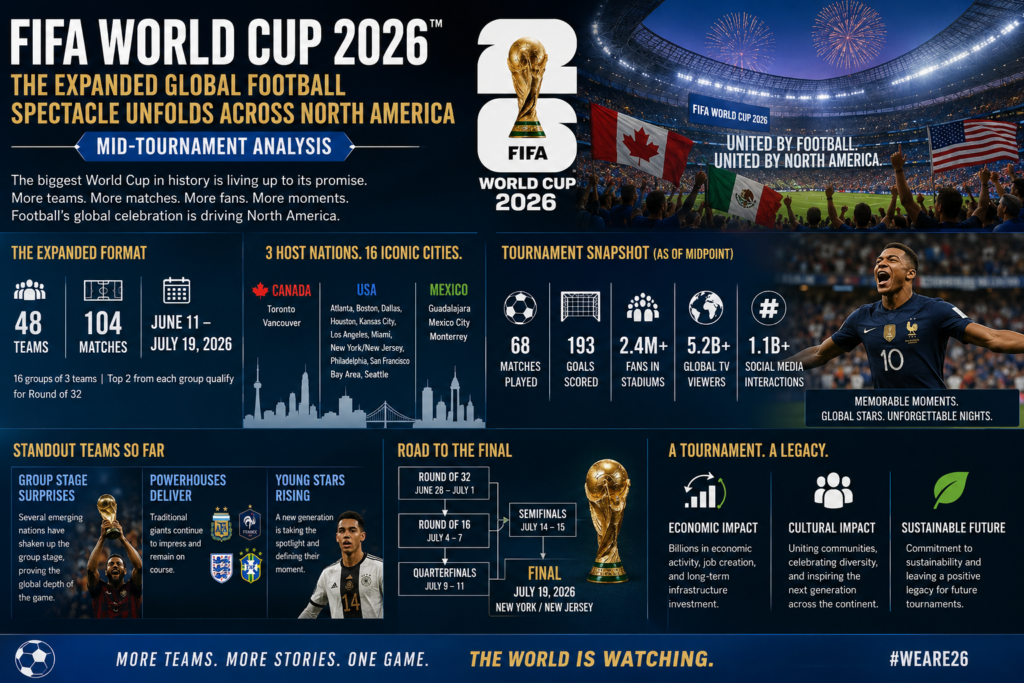
FIFA World Cup 2026: The Expanded Spectacle Unfolds Across North America – A Mid-Tournament
The 23rd edition of the FIFA World Cup, the first to feature 48 teams and be co-hosted by three nations—Canada, Mexico, and the United States—has delivered a tournament of unprecedented scale, drama, and complexity. Kicking off on June 11, 2026, and scheduled to conclude on July 19 at MetLife Stadium (temporarily rebranded as New York/New Jersey Stadium) in East Rutherford, New Jersey, the event has already produced memorable moments, shocking upsets, political undercurrents, and logistical triumphs and challenges.
As the competition enters the latter stages of the Round of 16 on July 6, with fewer than half of the original 48 teams remaining, the narrative is one of resilience for underdogs, dominance by traditional powers, and the unique dynamics of a multi-nation host setup. This report chronicles the journey from qualification through the group stage and into the knockouts, weaving in key results, standout performances, controversies, fan experiences, and the broader context shaping this historic tournament.
The Road to 2026: Qualification and Expansion
The expansion to 48 teams marked a significant shift, approved years earlier to broaden global participation. Hosts Canada, Mexico, and the United States qualified automatically. The remaining 45 spots were fiercely contested across confederations from September 2023 to March 31, 2026.
UEFA (Europe) contributed powerhouses like Germany, England, France, Spain, Portugal, Belgium, and emerging sides including Norway, Sweden, Czechia, and Türkiye. Italy notably missed out after a playoff disappointment. Bosnia and Herzegovina and others also secured berths.
CONMEBOL (South America) saw Argentina (defending champions), Brazil, Uruguay, Colombia, Paraguay, and Ecuador advance. CONCACAF beyond the hosts included Curaçao (the smallest nation ever to qualify), Haiti, and others. CAF (Africa) featured Morocco, Senegal, Egypt, Nigeria (via strong campaigns), Côte d’Ivoire, and debutants or returnees like Cape Verde. AFC (Asia) had Japan, South Korea, Iran, Saudi Arabia, Australia, Iraq, Jordan, Uzbekistan, and Qatar. OFC sent to New Zealand.
Qualification was marked by marathon campaigns, with Iraq playing over 20 matches. Debuts and returns added freshness, though geopolitical tensions loomed, particularly around Iran.
Preparations and Host Cities: Ambition Meets Reality
Sixteen venues across the three countries were selected: 11 in the US (Atlanta, Boston, Dallas, Houston, Kansas City, Los Angeles, Miami, New York/New Jersey, Philadelphia, San Francisco Bay Area/Seattle, etc.), three in Mexico (Mexico City’s Estadio Azteca, Guadalajara’s Estadio Akron, Monterrey’s Estadio BBVA), and two in Canada (Toronto and Vancouver).
AT&T Stadium in Arlington, Texas (Dallas area), hosts the most matches (nine), while MetLife Stadium hosts the final. Infrastructure upgrades, fan zones, and transportation plans were rolled out, but challenges emerged: scheduling conflicts with MLB and CFL seasons, public transit strains in some US cities, and cost overruns in Canada.
Extreme heat protocols, including hydration breaks, were implemented. Ticket pricing, especially dynamic models pushing final tickets toward $11,000, sparked outrage and investigations.
Opening Ceremony and Kickoff: Celebration Amid Tension
The tournament opened on June 11 in Mexico City with Mexico facing South Africa. The ceremony at Estadio Azteca was a vibrant showcase of Mexican culture—mariachi, folklore, fireworks, and performances—praised as emotionally resonant. Subsequent events in Toronto and Los Angeles featured global stars like Katy Perry, Tyla, Lisa (BLACKPINK), Anitta, Rema, Michael Bublé, and others, blending pop, hip-hop, and local flavours. Salma Hayek presented the Parade of Nations.
Mexico triumphed 2-0 over South Africa in the opener, setting a positive tone for the hosts.
Group Stage: Drama, Surprises, and Host Progress
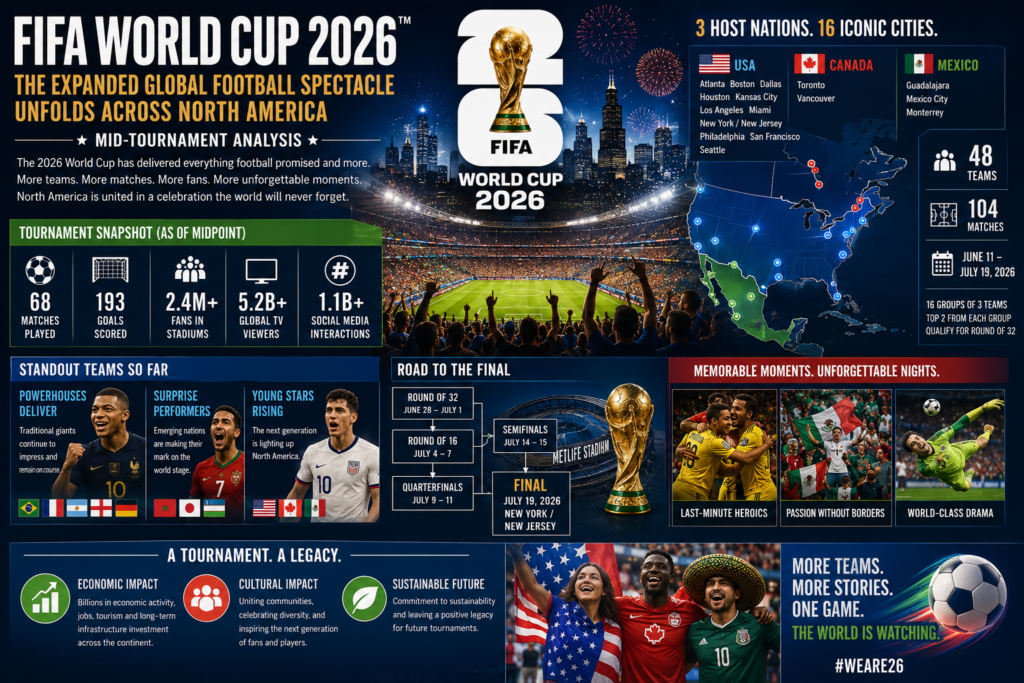
The group stage featured 12 groups of four, with the top two plus the eight best third-placed teams advancing to a 32-team Round of 32. Matches were spread across venues, creating a marathon of football.
Group A (Mexico City, Guadalajara, etc.): Co-host Mexico dominated with three wins, including 2-0 over South Africa and strong results against South Korea and Czechia, finishing with a +6 goal difference. South Africa advanced as runners-up.
Group B: Switzerland topped with strong form; Canada (co-host) advanced despite mixed results, showcasing Alphonso Davies’ impact.
Group D: USA, under Mauricio Pochettino, won the group with victories over Paraguay and Australia, losing to Türkiye but advancing comfortably. They defeated Bosnia & Herzegovina in the Round of 32.
Other notable groups saw Brazil, France, England, Argentina, Spain, Germany, Belgium, Morocco, and Norway progress. Upsets included strong showings from Cape Verde, Curaçao, and underdogs like Haiti or New Zealand in patches. Defending champions Argentina navigated a tough path, facing multiple African sides.
Standout individual performances: Erling Haaland for Norway, Kylian Mbappé for France, Harry Kane for England, and veterans like Lionel Messi and Neymar (whose goal marked a swan song moment).
By late June/early July, the Round of 32 saw thrilling ties, with many matches going to extra time or penalties. Hosts progressed: Mexico, USA, and Canada reached the Round of 16.
Knockout Stage So Far: High Stakes and Classics
As of July 6, the Round of 16 is underway. Key results include:
- England defeated Mexico 3-2 in a thrilling clash at Mexico City Stadium (Azteca), described as a “World Cup classic.” Harry Kane and Thomas Tuchel’s side edged El Tri.
- Norway stunning Brazil 2-1, with Haaland starring; Neymar scored in what appeared to be a farewell.
- France advanced past Paraguay 1-0 via Mbappé’s penalty.
- USA preparing to face Belgium in Seattle.
Remaining Round of 16 fixtures include Portugal vs Spain, Switzerland vs Colombia, and others. Quarterfinals loom with matchups like France vs Morocco, potential England vs Norway, and USA/Belgium winner paths.
The expanded format has led to more competitive depth but also fatigue, with tight scheduling across vast distances.
Standout Stories and Performances
- Host Nations: Mexico’s early dominance and passionate support; USA’s solid campaign under Pochettino; Canada’s historic Round of 16 berth with Davies shining.
- Underdogs: Norway’s quarterfinal push, Cape Verde’s debut impact, South Africa’s resilience.
- Veterans: Messi’s continued brilliance for Argentina, potential last dances for Ronaldo (Portugal) and others.
- Tactical Notes: High pressing, set-piece mastery, and adaptations to heat/humidity defined many games.
Fan zones in cities like Los Angeles (LA Memorial Coliseum), Seattle, and others have been vibrant hubs, though attendance and travel logistics varied.
Controversies: Politics, Logistics, and Beyond
This World Cup has been one of the most politically charged. US visa and immigration policies under the second Trump administration impacted fans and officials from nations like Iran, Haiti, and others, with travel bans, detentions, and ticket revocations. Iran’s participation was complicated by geopolitical conflicts, with training relocated and threats of withdrawal.
Ticket prices, dynamic pricing, and commercial interruptions during hydration breaks drew criticism. Environmental concerns over the carbon footprint of 104 matches and travel persist. Security, labor issues at venues, and cartel-related worries in parts of Mexico added layers.
Media and fan debates rage over refereeing, VAR, and the sheer volume of games diluting some intensity, balanced by broader representation.
Economic and Cultural Impact
Billions in revenue expected for FIFA and hosts. Tourism boosted, but disparities in benefits across cities noted. Culturally, the tournament fosters unity amid divisions, with cross-border fan travel between hosts. Social media buzzes with highlights, memes, and debates.
Broadcasting reaches record audiences, with FOX, FS1, and global partners delivering coverage.
Looking Ahead: Quarterfinals to Final
With powerhouses like France, England, Argentina, Brazil (despite loss), Spain, and Germany still in contention, the path to MetLife is wide open. Potential dream finals or clashes abound. USA’s home advantage in later stages could be pivotal.
The 2026 World Cup embodies football’s evolution—bigger, more inclusive, yet challenged by modernity’s complexities. As matches intensify, the focus returns to the pitch: 22 players, one ball, global glory.
This tournament, midway through, has already etched legends. Whether it crowns a new champion or reaffirms old ones, its legacy as the North American World Cup will endure—flawed, spectacular, and unforgettable.
==