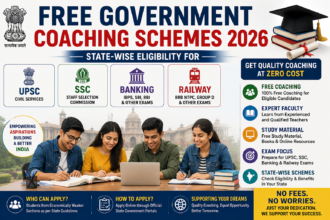


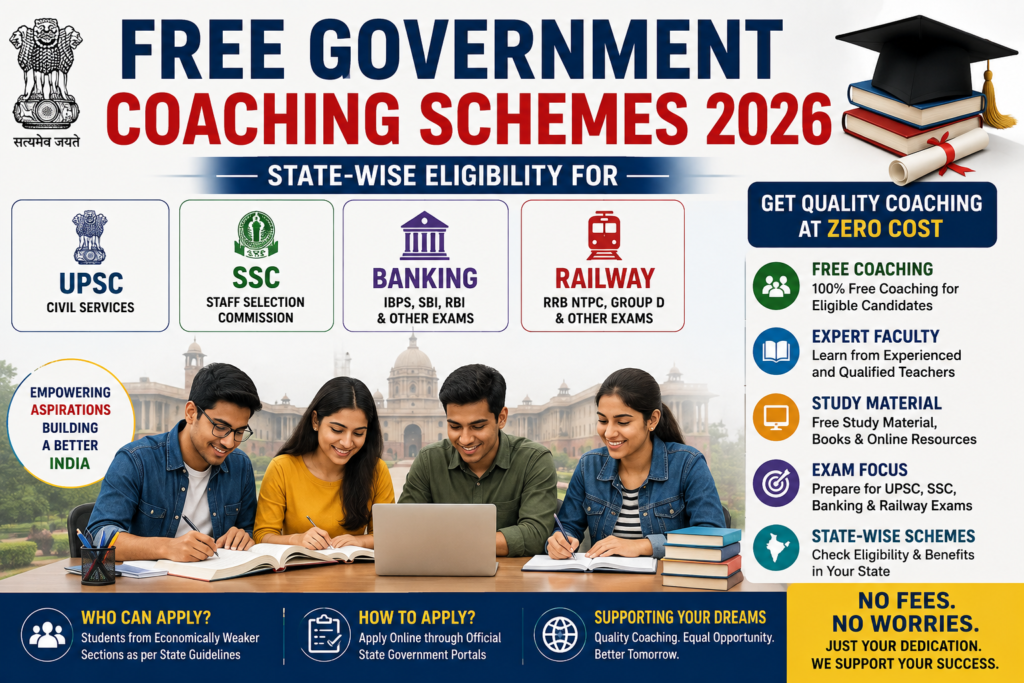
New Delhi, August 17, 2026 — In a significant push to democratise access to quality preparation for India’s most competitive examinations, the Central and state governments have expanded free and subsidised coaching programmes targeting aspirants for the Union Public Service Commission (UPSC) Civil Services, Staff Selection Commission (SSC), banking and insurance recruitments, and Railway Recruitment Board (RRB) exams. The latest impetus came from Prime Minister Narendra Modi’s Independence Day address on August 15, 2026, when he announced a nationwide network of free online coaching centres. The initiative aims to ease the financial burden on poor and middle-class families, who collectively spend thousands of crores of rupees annually on private coaching.
The announcement builds on existing Central Sector schemes run by the Ministry of Social Justice and Empowerment, the Ministry of Minority Affairs, and digital platforms such as SATHEE (Self-Assessment Test and Help for Entrance Exams) developed by IIT Kanpur in collaboration with the Ministry of Education. Parallel state-level programmes in Uttar Pradesh, Rajasthan, Maharashtra, Tamil Nadu, Bihar, Karnataka, Kerala, Telangana, and others continue to offer residential and non-residential coaching, stipends, and study material, primarily for Scheduled Caste (SC), Scheduled Tribe (ST), Other Backwards Classes (OBC), minority, Economically Weaker Section (EWS), and De-notified Tribes (DNT) candidates.
This report provides a detailed overview of the major Central and state schemes operational or expanded in 2026, eligibility criteria, benefits, application processes, and coverage for UPSC, SSC, banking, and railway examinations. Information is drawn from official guidelines, government portals, and recent announcements current as of mid-August 2026. Aspirants are advised to verify the latest notifications on official websites, as application windows, seat allocations, and income ceilings can change annually.
The Broader Context: Coaching Burden and Government Response
India’s competitive examination ecosystem has long been dominated by expensive private coaching institutes concentrated in cities such as Delhi, Kota, Hyderabad, and Pune. Annual fees for classroom programmes for UPSC or SSC can range from ₹50,000 to over ₹1.5 lakh, while multi-year preparation multiplies costs through accommodation, travel, and material expenses. For families with modest incomes, this creates a structural barrier that favours urban and relatively affluent candidates.
Government interventions have evolved over nearly two decades. The Free Coaching Scheme for SC and OBC students, originally launched in 2007 under the Ministry of Social Justice and Empowerment, has undergone several revisions. The latest guidelines incorporate beneficiaries of the PM CARES for Children Scheme and raise or adjust stipend and fee ceilings. Parallel efforts under the Ministry of Minority Affairs (earlier Naya Savera / Free Coaching and Allied Scheme) target notified minority communities. Digital platforms such as SATHEE, which had registered more than 21 lakh learners by early August 2026, provide free content for SSC, IBPS banking exams, and other tests in multiple Indian languages.
PM Modi’s 2026 announcement emphasises leveraging India’s digital public infrastructure, existing teacher talent, and online delivery to create a scalable free coaching network. Early industry reactions from major coaching providers have been cautiously positive, though questions remain about content quality, last-mile internet access, device availability, and the ability of online formats to replicate the discipline and peer environment of residential programmes.
Central Government Free Coaching Schemes
1. Free Coaching Scheme for SCs, OBCs and PM CARES Beneficiaries (Ministry of Social Justice and Empowerment)
This is the flagship Central Sector scheme providing coaching of good quality to economically disadvantaged SC, OBC, and PM CARES Children Scheme beneficiaries so they can compete for public- and private-sector jobs or secure admission to reputed professional institutions.
Coverage of examinations relevant to this report
- Group A and B examinations conducted by UPSC, SSC, and Railway Recruitment Boards (RRBs).
- Group A and B examinations of State Public Service Commissions.
- Banking, insurance, and Public Sector Undertaking (PSU) officer-grade examinations.
- Additional coverage includes JEE, NEET, CAT, CLAT, GATE, NDA, CDS, and others, but the scheme explicitly supports SSC/RRB and banking streams.
Eligibility (2024-25 / 2025-26 guidelines, continuing into 2026 with minor updates)
- SC or OBC candidates with total annual family income from all sources not exceeding ₹8 lakh.
- Beneficiaries of the PM CARES Children Scheme (no income or caste restriction).
- Candidates must meet the minimum educational qualifications prescribed for the target examination.
- OBC candidates must generally belong to the non-creamy layer.
- Minority-community SC/OBC candidates may be directed to the corresponding Ministry of Minority Affairs scheme.
Benefits
- Full payment of coaching fees up to prescribed ceilings (paid directly to empanelled institutes or universities). Approximate ceilings reported in recent notifications: ₹75,000 for UPSC/State PSC civil services (up to 12 months); ₹40,000 for SSC/RRB (6–9 months); ₹50,000 for banking/insurance/PSU/CLAT (6–9 months). Exact figures can vary by revision year.
- Monthly stipend (figures in recent circulars range from ₹3,000–₹4,000 for local students and higher for outstation students; some reports cite ₹6,000 for outstation). An additional special allowance (around ₹2,000) is available for students with 40% or more disability.
- One-time interview incentive (reported as ₹15,000 in some guidelines) after clearing the Mains stage of Class I/II civil services examinations.
- Stipend is disbursed via Direct Benefit Transfer (DBT) to the student’s Aadhaar-linked bank account for the duration of the course or one year, whichever is less.
Implementation model
In recent years, the scheme has increasingly operated through Dr Ambedkar Centres of Excellence (DACE) established in 19 empanelled Central Universities. These universities conduct their own screening (except for PM CARES beneficiaries, who are exempt). Earlier models relied more heavily on private empanelled coaching institutes. The official portal is coaching.dosje.gov.in or the Department of Social Justice and Empowerment website (socialjustice.gov.in). Application windows are typically announced annually, often in May or around the start of the academic coaching cycle.
Seats are limited (historically expanded to around 3,500 in some years). Selection is competitive and based on merit within the eligibility criteria.
2. Free Coaching and Allied Scheme / Naya Savera for Minority Communities (Ministry of Minority Affairs)
This scheme assists students from notified minority communities (Muslim, Christian, Sikh, Buddhist, Jain, and Parsi) with coaching for competitive examinations leading to Group A, B, and C services under Central and State governments, including banks, railways, and PSUs, as well as entrance examinations for professional courses.
Eligibility
- Belonging to a notified minority community.
- Annual family income ceiling (historically ₹6–8 lakh depending on the revision year; candidates must confirm the latest figure).
- Educational qualifications matching the target examination.
Benefits
- Coaching fee support paid to empanelled institutes.
- Monthly stipend (commonly ₹1,500 for day scholars and ₹3,000 for residential students in older guidelines; updated figures should be checked).
- Coverage explicitly includes UPSC/State PSC, SSC, RRB, bank PO/clerk, and related examinations.
Applications are processed through the Ministry of Minority Affairs portal or state minority welfare departments. Notifications often appear in the July–August window.
3. Free Coaching Scheme for De-Notified, Nomadic and Semi-Nomadic Tribes (DNT)
Administered under the Ministry of Social Justice and Empowerment / Development and Welfare Board for De-notified, Nomadic and Semi-Nomadic Communities (DWBDNC), this scheme provides coaching support for a wide range of competitive examinations, including UPSC/State PSC Group A/B, SSC, RRB, banking/insurance/PSU, and others.
Eligibility
- Belonging to a DNT community.
- Family income ceiling typically ₹2.5 lakh per annum in recent guidelines.
- Minimum qualifying marks in the relevant examination.
Benefits
- Fee reimbursement up to category-specific ceilings (e.g., ₹1,20,000 for UPSC/SPSC in some tables, ₹40,000 for SSC/RRB, ₹50,000 for banking).
- Monthly stipend of ₹1,500 (local) or ₹3,000 (outstation), plus ₹2,000 extra for persons with disability ≥40%.
- Application windows open twice a year in many cycles.
4. Residential Coaching Academies and University-Based Programmes
- Jamia Millia Islamia Residential Coaching Academy (RCA), New Delhi: Fully free residential coaching for UPSC Prelims and Mains for candidates from minority communities, SC, ST, and women. Funded with support linked to the Ministry of Minority Affairs and UGC. The academy has a strong track record (32 final selections in CSE 2024, including high ranks). Selection is through an entrance test. Limited seats (around 100 in recent cycles). A modest maintenance fee may apply. Applications are typically invited in May.
- Similar residential programmes exist at Aligarh Muslim University (AMU) RCA and selected Central Universities under the DACE model.
5. Digital and Open Platforms
- SATHEE (IIT Kanpur + Ministry of Education): Free online content, assessments, and guidance for SSC, IBPS banking examinations, and other competitive tests, available in multiple Indian languages. Over 21 lakh registered learners reported by August 2026. No income or caste restriction; open to all.
- DIKSHA and other national digital education platforms continue to host supplementary material.
- The new free online coaching network announced by the Prime Minister is expected to integrate and scale these resources further.
State-Wise Free Coaching Schemes (Selected Major Programmes)
State governments run parallel schemes, often focused on SC/ST/OBC/minority students or meritorious government-school candidates. Eligibility, benefits, and application processes vary. Below is a summary of prominent programmes relevant to UPSC, SSC, banking, and railway examinations as of 2026.
Uttar Pradesh – Mukhyamantri Abhyudaya Yojana
Provides free coaching (residential and non-residential, plus online components) for UPSC, UPPSC, SSC, banking, NDA/CDS, CAPF, and other examinations through a network of district-level and specialised centres. Selection is often through an entrance test. The scheme has produced successful candidates in CAPF and PCS. Applications are typically opened annually via the state education or social welfare portals.
Rajasthan – Mukhyamantri Anuprati Coaching Yojana
Covers UPSC, Rajasthan Administrative Services, SSC-type state exams, and other competitive tests for SC, ST, OBC, EWS, MBC, and minority students. Family income ceiling often ₹8 lakh. Benefits include coaching fee support or free coaching plus stipend (reported figures around ₹20,000–₹40,000 per year depending on relocation). Applications via the Social Justice and Empowerment Department portal (sje.rajasthan.gov.in).
Maharashtra – BARTI (SC), SARTHI (Maratha/OBC), Mahajyoti (OBC) and related schemes
These well-funded programmes support UPSC and other civil services preparation, often reimbursing full fees for reputed Delhi institutes plus providing stipends. Residential options and structured mentoring are available. Selection is competitive. The schemes have contributed candidates to CSE final lists in recent years.
Tamil Nadu – Anna Institute of Management / All India Civil Services Coaching Centre
Long-running residential and non-residential coaching for UPSC and state services. Approximately 325 aspirants annually (225 residential). Free coaching, boarding, and food for residential candidates. Strong historical selection record.
Bihar – Free Coaching Yojana / related programmes
Offers coaching across district centres for UPSC, BPSC, SSC, and other exams, particularly for backward and extremely backward class students. Monthly stipend (around ₹3,000) linked to attendance requirements is common. Six-month programmes are typical.
Karnataka – Pre-Examination Training / Directorate of Minorities programmes
Free coaching for minority candidates for UPSC, KAS, KPSC Group-C, RRB, and SSC through empanelled institutes. Degree holders from minority communities are eligible. Selection often involves a competitive exam conducted by the Karnataka Examination Authority. Applications via Seva Sindhu or the Directorate of Minorities portal. Separate schemes exist for SC/ST students through social welfare departments.
Kerala – Kerala State Civil Services Academy and KITE initiatives
Residential and technology-enabled coaching for civil services and other competitive examinations. Emphasis on integrating AI-based tools and public education infrastructure.
Telangana – SC/ST/BC Study Circles
Well-established free coaching centres for UPSC, state services, SSC, banking, and related exams, primarily for reserved categories.
Uttarakhand – Mukhyamantri Yuva Bhavishya Nirman Yojana-2026
Recently approved free online coaching and study material for students in higher educational institutions preparing for UPSC, State PSC, CDS, SSC, and RRB examinations.
Other states
- Chhattisgarh: Rajiv Yuva Utthan Yojana for SC/ST/OBC with free coaching and stipend.
- Delhi: Jai Bhim Mukhyamantri Pratibha Vikas Yojana (primarily JEE/NEET but with competitive exam components for SC/ST).
- West Bengal, Madhya Pradesh, Gujarat, and others maintain social-welfare-linked coaching centres or Super-100-type residential programmes that sometimes extend to SSC/banking streams.
Aspirants should monitor their State Social Welfare, Tribal Welfare, Minority Welfare, or Higher Education department websites for annual notifications. Many states also reimburse fees for private coaching or run hybrid online–offline models.
Application Process and Practical Tips
- Identify the correct scheme: Match your category (SC/ST/OBC/minority/DNT/EWS/PM CARES), income, and target examination.
- Check official portals: coaching.dosje.gov.in, socialjustice.gov.in, minorityaffairs.gov.in, scholarships.gov.in, state portals, and university websites (e.g., jmi.ac.in for Jamia RCA).
- Prepare documents: Caste/income certificates, educational marksheets, Aadhaar, bank details, disability certificate if applicable, and recent passport photographs.
- Entrance tests: Many residential and high-demand programmes require a screening test modelled on the target examination.
- Timelines: Central schemes often open in May or around the financial year start; state schemes vary. Monitor newspapers and official social media.
- Attendance and performance conditions: Stipends are frequently linked to minimum attendance (e.g., 75%).
- Complement with free resources: Use SATHEE, NCERT textbooks, PIB, PRS India summaries, and UPSC/SSC previous-year papers regardless of scheme enrolment.
Challenges and the Road Ahead
Despite expansion, challenges persist. Seat numbers remain limited relative to demand. Quality variation across empanelled institutes and state centres is a concern. Online delivery, while scalable, requires reliable internet, devices, and self-discipline. The new national free coaching network announced in August 2026 will need robust content curation, teacher training, and monitoring mechanisms to deliver measurable improvements in selection rates for under-represented groups.
At the same time, success stories from Jamia RCA, state study circles, and Central University DACE centres demonstrate that well-designed free programmes can produce results. The combination of targeted category-based schemes, open digital platforms, and the forthcoming national online network represents the most comprehensive government effort yet to reduce the coaching cost barrier for UPSC, SSC, banking, and railway aspirants.
Students and parents are encouraged to treat these schemes as enablers rather than guarantees. Consistent self-study, regular mock tests, and awareness of current affairs remain indispensable. For the latest updates, visit the official websites of the Ministry of Social Justice and Empowerment, Ministry of Minority Affairs, state social welfare departments, and the platforms announced under the new free coaching initiative.
(Disclaimer: This report is for informational purposes and synthesises publicly available scheme guidelines and news reports current as of August 2026. Always cross-verify with official notifications before applying.)