

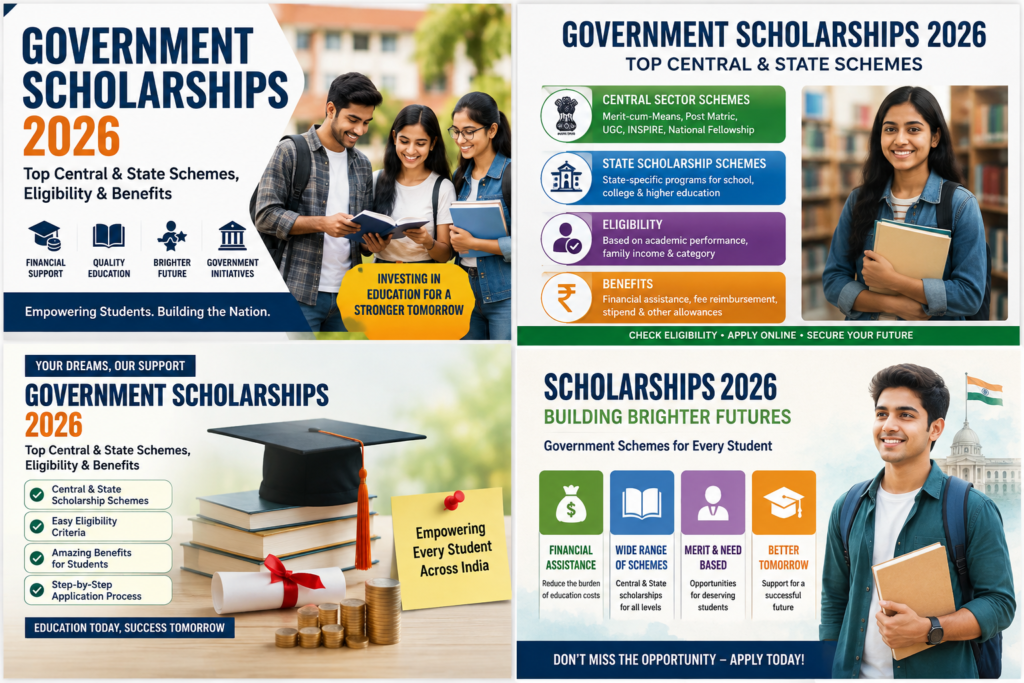
New Delhi, August 2026 — The Indian government has expanded its scholarship programs for the academic year 2026-27. Through the National Scholarship Portal (NSP) and state-level initiatives, over a crore students from economically weaker sections, marginalised communities, and meritorious backgrounds are set to receive financial support. The portal, managed by the Ministry of Electronics and Information Technology, opened applications on June 1, 2026, with key deadlines extending into October and November. This ecosystem of central sector, centrally sponsored, and state government schemes aims to reduce dropout rates, promote higher education, and foster inclusive growth under the broader vision of “Education for All.”
The scale is impressive. In FY 2025-26 alone, the central government disbursed approximately 1.09 crore scholarships for post-matric and higher education, including around 48 lakh for Scheduled Caste (SC) students, 24 lakh for Scheduled Tribe (ST) students, and 36 lakh for Other Backward Classes (OBC), Economically Backward Classes (EBC), and Denotified Tribes (DNT). As the 2026-27 cycle progresses, similar or expanded numbers are anticipated, supported by Direct Benefit Transfer (DBT) mechanisms that ensure funds reach Aadhaar-linked bank accounts efficiently.
The National Scholarship Portal: One-Stop Gateway
The National Scholarship Portal (scholarships.gov.in) serves as the primary platform for most central and many state schemes. Introduced to streamline applications, eliminate duplicates, and enhance transparency, NSP requires One-Time Registration (OTR) based on Aadhaar or Aadhaar Enrolment ID. This 14-digit unique number remains valid throughout a student’s academic career, simplifying renewals. Students can apply for one merit-based scheme and multiple welfare-based schemes simultaneously, subject to eligibility.
Key timelines for 2026-27 include:
- Registration and applications open: June 1, 2026
- Student application deadline: October 31, 2026 (varies slightly by scheme; pre-matric often earlier)
- Defective application and institute verification: until November 15, 2026
- District/State/Ministry nodal officer verification: until November 30, 2026
NSP services are also available at Common Service Centres (CSCs) for a nominal fee of Rs 30, aiding students in rural areas with biometric authentication and form filling. Face authentication issues have been addressed through updated Aadhaar apps, with advice to unlock biometrics if locked.
Eligibility generally requires Indian citizenship, enrollment in a recognised institution, Aadhaar linkage, an active bank account, and adherence to scheme-specific income ceilings (typically Rs 1–8 lakh annually) and attendance norms (often 75%). Documents commonly include income certificates, caste certificates (where applicable), marksheets, and domicile proofs.
Major Central Sector and Centrally Sponsored Schemes
Central schemes, administered by various ministries, form the backbone of the national effort. They target specific categories while promoting merit and equity.
PM-USP Central Sector Scheme of Scholarship for College and University Students (CSSS)
Administered by the Department of Higher Education, Ministry of Education, this merit-cum-means scheme awards up to 82,000–82,800 fresh scholarships annually (50% reserved for girls). Eligible students must rank in the top 80th percentile (or equivalent top 20%) of their Class 12 board examination and have a family income of up to Rs 4.5 lakh per annum. They must pursue regular (not distance) undergraduate or postgraduate courses in recognised institutions and not avail other scholarships.
Benefits: Rs 12,000 per annum for the first three years of graduation; Rs 20,000 per annum for the fourth/fifth years of professional courses or postgraduate studies. Funds are transferred via DBT. Applications are processed through NSP.
PM-USP Special Scholarship Scheme for Jammu & Kashmir and Ladakh
This scheme provides 5,000 fresh scholarships annually for students from these Union Territories pursuing graduate or integrated courses outside their home UTs. The family income limit is Rs 8 lakh. Benefits include tuition fee support (Rs 30,000 for general degree, Rs 1.25 lakh for professional, Rs 3 lakh for medical) plus a fixed Rs 1 lakh maintenance allowance.
PM-YASASVI (Young Achievers Scholarship Award Scheme for Vibrant India)
Under the Ministry of Social Justice and Empowerment, this umbrella scheme supports OBC, EBC, and DNT students. Components include pre-matric (Classes 9–10), post-matric, and top-class education in empanelled schools and colleges. Family income ceiling is generally Rs 2.5 lakh.
- Pre-matric (government schools): Consolidated Rs 4,000 per year.
- Top-class schools (Classes 9–10): Up to Rs 75,000 per year.
- Classes 11–12 top-class: Up to Rs 1.25 lakh per year (covering tuition and hostel).
- Higher education/professional: Group-based amounts ranging from Rs 5,000 to Rs 20,000 (academic allowance + tuition). Applications via NSP; selection prioritises merit within the income and category criteria.
Scholarships for SC, ST, and Minority Students
- Post-Matric and Pre-Matric Scholarships for SC/ST: Centrally sponsored, implemented by states. Income limit typically Rs 2.5 lakh. Benefits cover maintenance allowance (up to Rs 1,200+ per month for hostellers in higher groups), full or partial fee reimbursement, and other expenses. SC schemes are under the Ministry of Social Justice and Empowerment; ST under the Ministry of Tribal Affairs. Top-class education schemes for SC/ST provide full support in premier institutions (IITs, NITs, etc.).
- Minority Schemes (Ministry of Minority Affairs): Pre-matric (Classes 1–10, income up to Rs 1 lakh), Post-Matric (up to Rs 2 lakh), and Merit-cum-Means for professional/technical courses (up to Rs 2.5 lakh). Amounts include admission/tuition fees and maintenance (Rs 100–600+ per month depending on level and hosteller/day scholar status). Minimum 50% marks often required.
National Means-cum-Merit Scholarship Scheme (NMMSS)
For Class 9–12 students from economically weaker sections (income up to Rs 3.5 lakh in some reports, varying). Selected through exams, it provides Rs 12,000 per year to prevent dropouts at the secondary stage.
Scholarships for Persons with Disabilities
Department of Empowerment of Persons with Disabilities offers pre-matric, post-matric, top-class education, and national fellowships. Benefits cover fees, maintenance, and assistive devices where applicable.
AICTE Schemes
- Pragati Scholarship for girl students in technical degree/diploma courses: Rs 50,000 per year.
- Saksham for specially-abled students: Similar amount.
- Swanath for orphans, wards of armed forces personnel killed in action, etc.
Other Notable Central Schemes
- Prime Minister’s Scholarship Schemes for wards of Central Armed Police Forces, Assam Rifles, Railway employees, and police personnel martyred in terror/Naxal attacks.
- Financial assistance for wards of Beedi, Cine, IOMC, and LSDM workers (pre- and post-matric).
- National Overseas Scholarship for SC, DNT, etc., for Master’s and PhD abroad (125 slots annually; income up to Rs 8 lakh; 60% marks minimum).
- UGC National Scholarship for Post Graduate Studies (merged schemes providing Rs 15,000 per month for 10 months).
- Ishan Uday for North Eastern Region students.
- INSPIRE-SHE for science students.
Interest subsidy schemes under PM-USP CSIS provide full interest subsidy on education loans up to Rs 10 lakh during the moratorium period for eligible students.
State Government Scholarship Schemes: Tailored Regional Support
While NSP hosts many state schemes, most states maintain dedicated portals for localised programs that often offer higher benefits or broader coverage, including for general category students. These complement central efforts and address regional priorities such as girl child education, technical courses, and minority welfare.
Major State Portals and Schemes (2026 highlights):
- Uttar Pradesh: scholarship.up.gov.in — Pre- and post-matric for SC/ST/OBC/General/Minority; Kanya Vidya Dhan and other girl incentives. Income limits vary (e.g., Rs 2.5 lakh for some general schemes).
- Maharashtra: mahadbt.maharashtra.gov.in (MahaDBT) — Comprehensive for SC/ST/OBC/EBC/NT-VJNT/Minority, including Rajarshi Chhatrapati Shahu Maharaj scheme. Recent hikes in rates.
- Karnataka: SSP/karepass.cgg.gov.in — Vidyasiri (food and accommodation for OBC), Sanchi Honnamma, Deepika for girls, SC/ST post-matric.
- Tamil Nadu: tnscholarship.gov.in or related — Post-matric for SC/ST/BC/MBC, First Graduate scholarship, study abroad support (up to high amounts for select categories).
- West Bengal: Aikyashree (minority), Swami Vivekananda Merit-cum-Means, Bigyani Kanya Medha Britti.
- Andhra Pradesh: epass.ap.gov.in and Jagananna Vidya Deevena — Full or substantial fee reimbursement for eligible students.
- Telangana: telanganaepass.cgg.gov.in — Similar fee reimbursement and study abroad for SC/ST.
- Gujarat: digitalgujarat.gov.in / MYSY (Mukhyamantri Yuva Swavalamban Yojana) — Covers tuition and hostel for meritorious students (including general/EWS with high scores); Namo Laxmi for girls.
- Madhya Pradesh: scholarshipportal.mp.nic— Post-matric, Mukhyamantri Medhavi Vidyarthi Yojana, Gaon Ki Beti.
- Bihar: medhasoft.bih.nic.in or related — Post-matric, Chief Minister Kanya Utthan Yojana (incentives for girls post-Class 12 and graduation).
- Rajasthan: sje.rajasthan.gov.in — Post-matric and Mukhyamantri Uchch Shiksha schemes for various categories, including EWS.
- Odisha: scholarship.odisha.gov.in — e-Medhabruti (merit), post-matric, PRERANA.
- Kerala: DCE scholarship portal / e-Grantz — Strong support for SC/ST/OEC and other categories.
- Other states including Haryana (Gaon Ki Beti), Punjab, Jharkhand, and northeastern states offer ST-focused, merit, and technical scholarships, often with state-specific income and domicile rules.
State schemes frequently reimburse full tuition fees for professional courses, provide maintenance allowances, and include special incentives for girls, first-generation learners, or students from specific districts. Deadlines often align with or follow NSP windows (July–November 2026). Students must check domicile requirements carefully, as benefits are usually restricted to permanent residents.
Application Process, Challenges, and Best Practices
The process is largely online: Generate OTR via Aadhaar, log in to NSP or the state portal, select schemes, fill details (auto-populated where possible), upload documents, and submit. Institutes verify applications, followed by nodal officers. Status can be tracked on the portal. Renewals for continuing students are streamlined.
Common challenges include incomplete documentation, income certificate delays, Aadhaar-bank seeding issues, and verification backlogs. Officials advise early application, regular status checks, and follow-up with institutes. Students receiving one scholarship may be ineligible for overlapping ones, so careful selection is essential. Fake portals and agents remain a risk; always use official websites.
In 2026, the government has emphasized expansion, with higher allocations and integration of technology (including CSC outreach and mobile apps). Recent parliamentary updates highlight sustained commitment to equitable access, alongside complementary initiatives like One Nation One Subscription for journals and PM-Vidyalaxmi for education loans.
Impact and Outlook
These scholarships have transformed lives by enabling first-generation learners to enter colleges, reducing financial stress on families, and boosting female participation (many schemes reserve seats or offer higher benefits for girls). By covering school to PhD levels and professional courses, they align with India’s demographic dividend and goals under NEP 2020.
As deadlines approach in late 2026, education departments and schools are urged to guide students. Parents and applicants should verify the latest guidelines on official portals, as amounts, income limits, and dates can see minor revisions. For personalized eligibility, the NSP “Scholarship Eligibility” tool and state portals provide filters.
In summary, the 2026 scholarship landscape represents a robust, multi-layered safety net. From the central CSSS and PM-YASASVI to state fee reimbursements in Andhra Pradesh or Maharashtra’s MahaDBT, opportunities abound for eligible students. Timely application through scholarships.gov.in and state portals can unlock pathways to quality education and brighter futures. Students are encouraged to act promptly, gather documents, and leverage available support systems to claim their rightful benefits.
{Disclaimer: Information compiled from official announcements, Ministry sources, and verified reports as of mid-2026. Always cross-check current details on official websites as schemes may have updates.}