

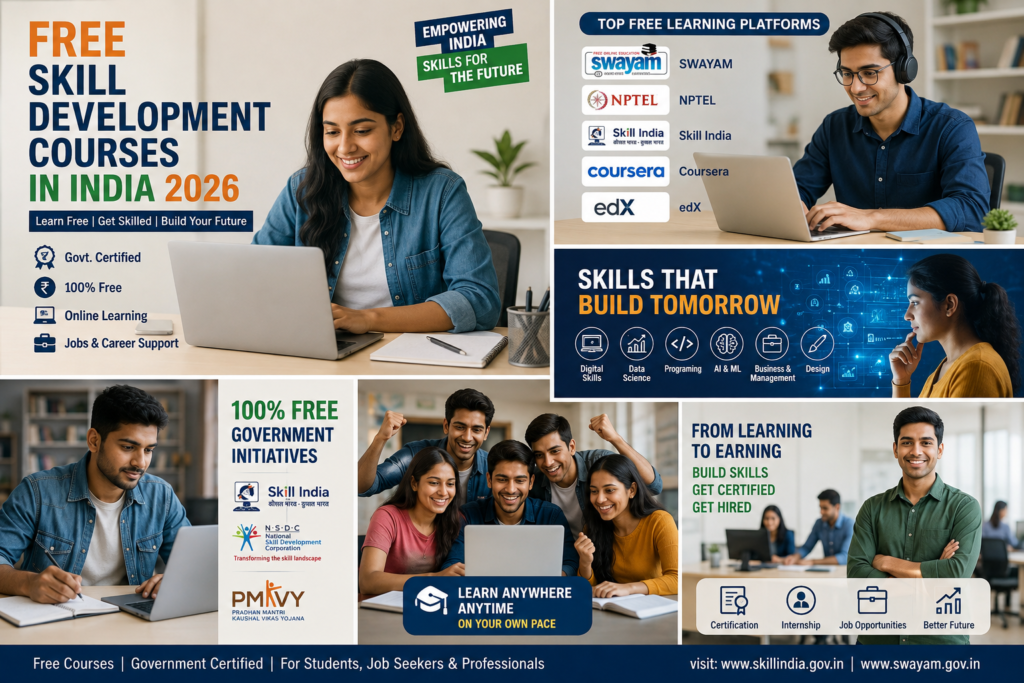
In 2026, India continues its journey toward becoming a global skills powerhouse under the Skill India Mission. With a young population—over half under 30—and rapid economic shifts driven by digital transformation, green energy, and Industry 4.0 technologies, the demand for skilled workers remains high. Through the Ministry of Skill Development and Entrepreneurship (MSDE) and partners like the National Skill Development Corporation (NSDC), the Government of India offers a wide range of completely free skill development courses for students, school and college dropouts, unemployed youth, women, rural populations, and working professionals seeking upskilling.
The flagship initiatives include Pradhan Mantri Kaushal Vikas Yojana (PMKVY) 4.0, the Skill India Digital Hub (SIDH), Deen Dayal Upadhyaya Grameen Kaushalya Yojana (DDU-GKY), SWAYAM/NPTEL platforms, Skilling for AI Readiness (SOAR), and various sector-specific and state-level programs. Many courses provide government-recognised National Skills Qualifications Framework (NSQF)-aligned certificates, often stored digitally in DigiLocker for easy verification. Benefits frequently extend beyond training to include placement assistance, stipends in residential programs, on-the-job training (OJT), and linkages to apprenticeships or entrepreneurship support.
As of mid-2026, PMKVY 4.0 alone has trained over 28 lakh candidates across 36 sectors and 738 districts, with significant focus on emerging technologies like artificial intelligence (AI), where more than 5 lakh candidates have been trained in future-skill roles. Recent announcements by Prime Minister Narendra Modi, including AI skill training for 1 crore youth and free online coaching for competitive exams, underscore the national priority. This report provides a detailed overview of the major free programs available in 2026, eligibility, popular sectors and courses, application processes, benefits, challenges, success metrics, and future outlook. It draws on official schemes and publicly available data to guide learners, educators, and policymakers.
The Skill India Ecosystem and Policy Framework
The Skill India Mission, launched in 2015, integrates multiple schemes under a composite framework. In recent years, the Cabinet approved continuation and restructuring of the Skill India Programme with an outlay supporting PMKVY 4.0, the Pradhan Mantri National Apprenticeship Promotion Scheme (PM-NAPS or NAPS), and Jan Shikshan Sansthan (JSS) until at least the end of 2026. The total emphasis is on demand-driven, industry-aligned, technology-enabled training.
Key principles include NSQF alignment for standardisation, integration of digital platforms, focus on emerging and green skills, inclusion of marginalised groups (SC/ST, OBC, women, rural youth, persons with disabilities), and outcome orientation through placement tracking and certification. The Skill India Digital Hub (SIDH) at skillindiadigital.gov.in serves as the unified digital public infrastructure, linking skilling with education, employment (via National Career Service or NCS), entrepreneurship, and portals like e-Shram and DigiLocker. It supports multilingual access, AI-powered recommendations, digital CVs, and verifiable credentials.
Budgetary support and industry partnerships with companies like Microsoft, IBM, AWS, Google, and sector skill councils ensure relevance. Emerging priorities in 2026 include AI readiness, green jobs (solar, EV, green hydrogen), cybersecurity, drones, robotics, and caregiving, reflecting national goals under Viksit Bharat and global competitiveness.
Pradhan Mantri Kaushal Vikas Yojana (PMKVY) 4.0
PMKVY 4.0 is the cornerstone free skill development scheme. Extended until 31 December 2026 with an expanded target of training around 3 crore youth, it focuses on short-term training (STT), special projects, and Recognition of Prior Learning (RPL). Training is fully government-funded for eligible candidates; trainees do not pay for courses, assessment, or certification.
Eligibility: Indian nationals with a valid Aadhaar, typically aged 15–45 (some components up to 59), including school/college dropouts, unemployed youth, and those meeting job-role-specific criteria. Priority is often given to women, SC/ST/OBC, and economically weaker sections. RPL requires prior relevant experience.
Components and Duration: STT courses generally range from 150–600 hours (roughly 2 weeks to several months), incorporating OJT for practical exposure. Blended (online + offline) and fully online options are available via SIDH. Residential training may include stipends or conveyance support (reports vary by batch and location, with some mentioning daily or monthly allowances). Completion often includes insurance coverage.
Sectors and Courses: Over 40 sectors and hundreds of job roles, with strong emphasis on future skills. Popular areas include:
- Emerging Technology: AI and Machine Learning, Data Science, Cybersecurity, Cloud Computing, Robotics, IoT, Drones, AR/VR, 5G, Semiconductors.
- Green Jobs: Solar PV Installer (Suryamitra), EV servicing, Green Hydrogen.
- Healthcare: General Duty Assistant, Home Health Aide, Multi-Skilled Caregiver (new push for 1.5 lakh caregivers), Telehealth Coordinator.
- Digital and IT: Digital Marketing, Coding (Python, etc.), Web Development, Data Entry.
- Traditional and Service: Electrician, Beauty & Wellness, Retail, Hospitality, Construction, Logistics, Agriculture-related.
As of mid-2026 data, over 5 lakh candidates have been trained in AI and emerging tech roles, with overall PMKVY 4.0 training exceeding 28 lakh across districts. Certificates are NSQF-aligned and digitally verifiable.
How to Apply: Register on skillindiadigital.gov.in (SIDH). Complete profile with Aadhaar e-KYC, browse courses by sector/location/mode, select a nearby empanelled training centre or online option, and enrol. Helpline support is available (e.g., 8800-055-555). Batches run on a rolling basis; check for seat availability.
Benefits: Free training and certification, practical skills with OJT, placement assistance through job fairs and industry linkages, potential stipends in residential modes, and pathways to apprenticeships or self-employment (some reports of seed support or post-training incentives in specific implementations). Certificates enhance employability in both private and public sectors.
Skill India Digital Hub (SIDH) and Related Online Platforms
SIDH is the central free online and hybrid learning platform aggregating thousands of courses from NSDC, sector skill councils, NASSCOM, NIELIT, and partners. It offers self-paced and instructor-led options across IT, digital marketing, healthcare, beauty, retail, construction, and more. Features include personalised recommendations, multilingual support (via Bhashini integration for regional languages), AI chatbots (Skill India Assistant), digital CV creation, job and apprenticeship discovery linked to NCS, and DigiLocker credentials.
Many courses are short (a few hours to weeks) and free, with certificates upon completion of quizzes/assessments. Examples include AI for All modules, Power BI, network security, IoT security, and vocational trades. Registration is open year-round for Indian citizens.
Complementary platforms include:
- SWAYAM and NPTEL/Swayam Plus: Free courses from IITs, IISc, and universities. Content is free; optional proctored exams (nominal fee in some cases) for certificates and academic credit. In 2026, IIT Madras’ Swayam Plus launched “AI for All” courses in Hindi (e.g., AI for Educators, AI in Physics/Chemistry/Accounting, AI/ML using Python, Cricket Analytics), spanning 25–45 hours, free to access, with a paid certification option. Over 500 courses across sectors; BHU has offered 121 skill courses in multiple languages starting early 2026.
- SOAR (Skilling for AI Readiness): Launched for Classes 6–12 students and educators, covering AI basics, generative AI, programming, ethics, cybersecurity. Enrolments reached hundreds of thousands by early-mid 2026, with expansions to 50+ AI qualifications.
- NASSCOM FutureSkills Prime and similar: Free or freemium IT/AI/cybersecurity modules often accessible via government portals.
- Other: CBSE free online skill courses for Classes 8–12 (AI, Python, Generative AI, Cybersecurity, IoT, 3D printing, etc.); Startup India Learning Program for entrepreneurship; sector initiatives like AI skilling for 15,000 creators/students in media/animation/gaming via Ministry of Information and Broadcasting partnerships with Google/YouTube.
Deen Dayal Upadhyaya Grameen Kaushalya Yojana (DDU-GKY)
DDU-GKY targets rural poor youth (primarily 15–35 years, with some flexibility) for placement-linked skill training. It is free, often residential (covering food, accommodation, and training costs), and focuses on guaranteed or assisted employment at or above minimum wages. Implemented under the Ministry of Rural Development through State Rural Livelihood Missions, with Project Implementing Agencies (PIAs).
Eligibility and Benefits: Rural youth from poor households; priority for disadvantaged groups. Training durations typically 3–12 months with OJT. Benefits include free training/boarding, soft skills, placement support (targets often 50%+ placement), post-placement tracking, and sometimes stipends or incentives. Over 18 lakh rural youth have been trained historically, with strong placement outcomes in many projects. In 2026, DDU-GKY 2.0 emphasises digital reforms, unified portals (kaushal.rural.gov.in or similar), better monitoring, and expanded access.
Application: Through state SRLM portals, Kaushal Bharat/Kaushal Pragati platforms, or local centres. Candidates can search available batches by district and trade (e.g., healthcare, hospitality, IT, drones, mobile technician, data entry).
Other Key Schemes
- National Apprenticeship Promotion Scheme (NAPS): Promotes workplace-based learning with stipend support (government shares portion). Linked to PMKVY and ITIs.
- Jan Shikshan Sansthan (JSS): Non-formal vocational training for non-literates, neo-literates, and school dropouts, especially women and rural/semi-urban populations, through NGOs. Courses in traditional skills, entrepreneurship, and basic digital literacy.
- ITI and Craftsmen Training Scheme (CTS): Free or low-cost long-term vocational training in government ITIs; upgrades under PM-SETU (₹60,000 crore scheme for 1,000 ITIs).
- Specialised Initiatives: Multi-skilled caregiver training; AVGC (Animation, Visual Effects, Gaming, Comics) content creator labs; PM Vishwakarma for traditional artisans (upskilling, toolkits, credit); state-specific programs and SC/ST-focused free courses via National Career Service Centres.
- Competitive Exam Support: Free online coaching networks announced in 2026, building on platforms like SATHEE (IIT Kanpur) for JEE, NEET, CUET, SSC, etc.
Popular High-Demand Skills and Career Pathways in 2026
High-demand areas align with economic trends:
- AI and Digital: Roles in data analysis, prompt engineering, AI applications in sectors, and cybersecurity. Pathways to IT jobs, freelancing, or further specialisation.
- Green and Sustainable: Solar technicians, EV maintenance—linked to renewable energy targets and schemes like PM Surya Ghar.
- Healthcare and Caregiving: Growing due to demographics and post-pandemic needs; multi-skilled caregivers in high demand.
- Creative and Media: Animation, gaming, digital content with AI tools.
- Core Trades: Electrician, plumbing, retail, hospitality for immediate local employment or self-employment.
Certificates improve resume visibility, support government job applications, and facilitate higher education credit transfer in some cases. Placement rates vary by program and location but are actively tracked; industry partnerships and Kaushal Melas enhance outcomes. Self-employment is encouraged through entrepreneurship modules and linkages to credit schemes.
How to Choose and Succeed in Free Courses
Assess personal goals (job, entrepreneurship, upskilling), location (online vs. local centre), education level, and time availability. Prioritise NSQF-aligned certificates. Complete profiles fully on SIDH for personalised recommendations. Engage actively in OJT and soft skills components. Verify centres on official portals to avoid unofficial claims of fees. After certification, use NCS/JobX for jobs, update digital CV, and consider apprenticeships or further courses.
Challenges include varying quality across training partners, awareness gaps in remote areas, digital literacy barriers for pure online modes, and competition for popular batches. Solutions involve SIDH’s accessibility features, multilingual content, community outreach via panchayats and SRLMs, and continuous monitoring by MSDE/NSDC. Impact evaluations (e.g., third-party assessments) guide improvements.
Impact, Statistics, and Success Stories
Employability has improved, with India Skills Report indicators showing gradual rises. Millions have been certified under Skill India components. AI-focused enrolments under SOAR and PMKVY demonstrate rapid scaling. Rural programs like DDU-GKY have diversified incomes for poor families. Women and marginalised groups benefit from targeted inclusion. Digital credentials enhance portability and trust among employers.
Individual successes often involve a transition from unemployment or informal work to formal jobs in retail, IT support, healthcare, or green sectors, or starting micro-enterprises. Broader impact supports Atmanirbhar Bharat by reducing skill mismatches and boosting productivity.
Challenges and Recommendations
Despite progress, challenges persist: ensuring consistent quality and placement outcomes, bridging urban-rural digital divides, aligning curricula faster with industry (especially AI ethics and advanced applications), and scaling trainer capacity. Recommendations include stronger industry co-creation of courses, expanded RPL for informal workers, greater focus on lifelong learning pathways, integration with school education (NEP 2020 alignment), and robust feedback mechanisms. Learners should cross-verify information on official portals and combine free courses with practical projects or internships.
Future Outlook Beyond 2026
With PMKVY 4.0 concluding by the end of 2026 and PMKVY 5.0 anticipated, the focus will intensify on future skills, outcomes-based financing (e.g., Skills Outcomes Fund concepts), ITI modernisation via PM-SETU, and AI skilling at population scale. Integration of digital public infrastructure will deepen personalisation and job matching. As India aims for developed-nation status, free skill development remains a critical equaliser, empowering youth to lead in AI, green economy, and global services.
Conclusion
Free skill development courses in India in 2026 represent one of the world’s largest accessible skilling ecosystems. Through PMKVY 4.0, SIDH, DDU-GKY, SWAYAM/NPTEL, SOAR, and allied programs, anyone with motivation and basic eligibility can acquire industry-relevant skills at zero cost, earn recognised certificates, and access pathways to employment or entrepreneurship. The emphasis on AI, digital, green, and care skills positions participants for the jobs of today and tomorrow. Aspiring learners should visit skillindiadigital.gov.in, register promptly, select courses aligned with interests and local opportunities, and complete them diligently. Continuous government investment, industry collaboration, and individual initiative will determine how effectively this human capital transforms into national prosperity. The opportunity is open—seize it to build a skilled, self-reliant future.
(Disclaimer: Information is based on publicly available reports and scheme details current as of mid-to-late 2026; always verify the latest batch details, eligibility nuances, and portals on official government websites, as implementations can vary by state and update periodically.)