

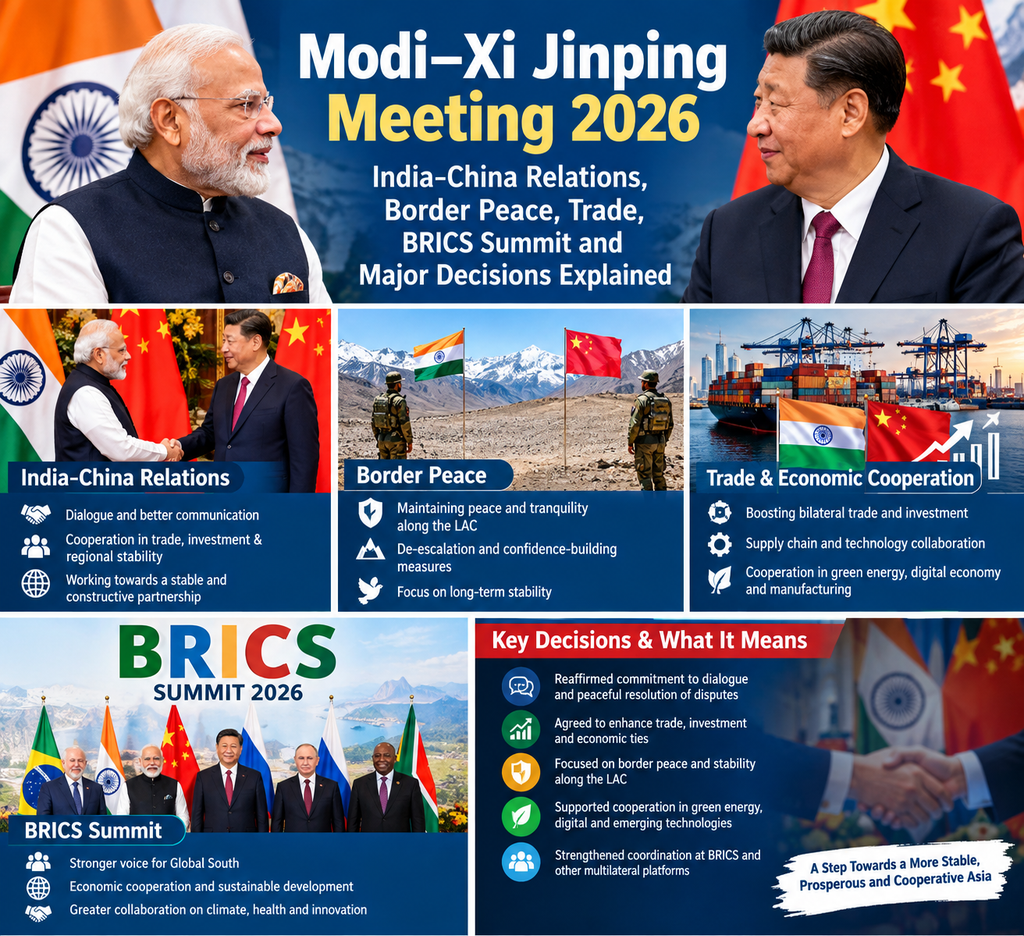
New Delhi, September 12, 2026 — In a significant diplomatic engagement marking Chinese President Xi Jinping’s first visit to India in nearly seven years, Prime Minister Narendra Modi and Xi held bilateral talks on the sidelines of the 18th BRICS Summit at Bharat Mandapam in New Delhi. The 40- to 50-minute meeting, described by officials as positive and productive, focused on stabilising and advancing India-China relations after years of border tensions, with emphasis on peace and tranquillity along the frontier, addressing structural trade imbalances, promoting people-to-people ties and business linkages, and expanding cooperation within the expanded BRICS framework and on global issues.
The leaders welcomed the steady progress in bilateral relations since their previous meeting in Tianjin, China, in August 2025. They reaffirmed that both countries should view ties from a strategic and long-term perspective, stressed that differences should not become disputes, and committed to guiding the relationship by mutual respect, mutual sensitivity and mutual interest. Peace and tranquillity in the border areas was underscored as an essential basis for the continued development of relations, with both sides expressing commitment to a fair, reasonable and mutually acceptable resolution of the boundary question, approached from the political perspective of overall bilateral relations and the long-term interests of the two peoples. On the economic front, they agreed on the need to address concerns including the structural trade imbalance, supply-chain issues and facilitation of meaningful and predictable market access. They also noted progress in people-to-people ties and called for greater cultural exchanges, business linkages and mobility.
Xi, attending the BRICS Summit hosted by India under its 2026 chairmanship (theme: “Building for Resilience, Innovation, Cooperation and Sustainability”), arrived in New Delhi on September 12. This was his first visit to India since the informal summit in Mamallapuram (near Chennai) in October 2019. The meeting carried weight as the first bilateral engagement between the two leaders on Indian soil since the deadly Galwan Valley clash of June 2020, which killed 20 Indian soldiers and at least four Chinese personnel and triggered a prolonged military standoff along the Line of Actual Control (LAC) in eastern Ladakh.
Historical Context: From Galwan to Cautious Thaw
India and China share a roughly 3,500–3,800 km disputed border in the Himalayas that remains largely undemarcated. Relations, long characterised by both cooperation and competition as the world’s two most populous nations and major emerging economies, deteriorated sharply after the Galwan incident. High-level political contact froze for years, direct flights and many people-to-people exchanges were suspended, and both sides maintained heavy military deployments along the LAC. Multiple rounds of military and diplomatic talks followed, with incremental disengagements at friction points.
A breakthrough came in October 2024, when the two sides reached an agreement on patrolling arrangements in the Depsang and Demchok sectors of eastern Ladakh, restoring pre-May 2020 levels with verification protocols. This paved the way for the first formal bilateral meeting between Modi and Xi in five years, on the sidelines of the BRICS Summit in Kazan, Russia, in October 2024. There, the leaders endorsed the border understanding, agreed to revive the Special Representatives (SR) dialogue on the boundary question, and set a positive direction for ties.
Subsequent steps included further SR talks. National Security Adviser Ajit Doval and Chinese Foreign Minister Wang Yi held rounds that produced progress on border management. In August 2025, Modi and Xi met again in Tianjin on the sidelines of the Shanghai Cooperation Organisation (SCO) Summit — Modi’s first visit to China in seven years. They reviewed positive momentum since Kazan, reaffirmed the importance of peace and tranquillity in border areas, and committed to cooperation based on mutual respect, mutual interest and mutual sensitivity. Modi invited Xi to the 2026 BRICS Summit in India; Xi offered support for India’s chairmanship.
By 2026, institutional exchanges had gradually resumed, areas of cooperation expanded, and bilateral trade reached new highs (though with a large imbalance). Direct flights were being restored, business visas for Chinese professionals eased in some cases, and certain trade routes reopened. Yet substantial military deployments persisted along the LAC, and underlying territorial disputes — including Chinese claims over Arunachal Pradesh (referred to by Beijing as Zangnan or southern Tibet) — remained unresolved. Just days before the New Delhi meeting, senior military commanders held flag meetings in Arunachal Pradesh on September 6 and 7 amid local misunderstandings near Taksing.
In late August 2026, the 25th round of SR talks in Beijing between Doval and Wang Yi produced an eight-point consensus. The sides agreed to advance discussions on an “early and substantial harvest” of boundary delimitation (focusing on less contentious sections), establish mechanisms including new military hotlines and meeting points, and continue work on border management. This set the stage for the leaders’ engagement in New Delhi.
Key Outcomes of the September 12, 2026 Bilateral Meeting
According to the Ministry of External Affairs (MEA) statement:
- The leaders welcomed steady progress since Tianjin 2025 and reaffirmed a strategic, long-term perspective. Differences should not become disputes. Modi highlighted guidance by the three mutuals: mutual respect, mutual sensitivity and mutual interest.
- Peace and tranquillity in border areas remain essential for bilateral relations development. Both sides must observe existing agreements and understandings on border issues. They expressed commitment to a fair, reasonable and mutually acceptable resolution of the boundary question from the political perspective of overall relations and long-term interests of the peoples.
- Progress in people-to-people ties was noted; further promotion of cultural exchanges, business linkages and greater mobility was underscored.
- On economic and trade relations, the need to address each other’s concerns — including structural trade imbalance, supply-chain issues, and meaningful, predictable market access — was underlined.
- Both sides must continue expanding common ground on regional and global issues and in addressing challenges.
- Modi appreciated China’s support for India’s BRICS chairmanship and its contributions to the summit’s success. India indicated support for China’s upcoming BRICS chairmanship.
From the Chinese side, Xi emphasised that China approaches relations with India from a strategic and long-term perspective. He noted meetings over the past two years had guided ties from a new start toward further improvement. China and India should be partners rather than rivals, and development opportunities rather than threats to each other. Despite different national conditions, there is ample scope to learn from each other’s strengths, offer mutual support, achieve shared success and pursue common development. As the world’s two most populous nations and key Global South members, they bear significant responsibilities in a turbulent international landscape. They should work together to advance high-quality BRICS cooperation, advocate an equal and orderly multipolar world, and promote universally beneficial and inclusive economic globalisation.
Xi made observations on the steady development of ties, including calibrating direction with objective perception, managing differences properly while expanding cooperation, and supporting each other’s BRICS chairmanships while coordinating in the UN, SCO, G20 and other forums. India affirmed that its policy and position on Taiwan and Tibet remain unchanged and that it will not allow anti-China activities on its territory. Both sides agreed to maintain high-level exchanges, strengthen strategic communication, promote mutually beneficial cooperation and deepen people-to-people exchanges.
Participants included, on the Indian side, National Security Adviser Ajit Doval, External Affairs Minister S. Jaishankar (in some accounts), Foreign Secretary Vikram Misri and others; on the Chinese side, Cai Qi and Foreign Minister Wang Yi.
Trade Relations: Record Volumes, Persistent Imbalance
Economic ties featured prominently. Bilateral merchandise trade reached record levels in recent years. In FY 2025-26, total trade stood at approximately $151.10 billion according to some official Indian data, with China emerging as India’s largest trading partner (overtaking the US in some periods). Alternative figures cited two-way trade of around $127.7 billion (up 7.9% from the prior year). Indian exports to China grew strongly (around 36–37% to roughly $19.5 billion), while imports from China rose significantly (around 16% to $131–132 billion). The trade deficit widened to record levels, variously reported near $99–112 billion.
China accounts for a large share of India’s imports of electronics, machinery, computers, organic chemicals and other industrial inputs critical to manufacturing — roughly two-thirds of imports from China cluster in these categories, with China supplying 40%+ of certain key segments. This dependence creates both opportunities and vulnerabilities for Indian industry and supply-chain resilience. India has sought greater market access for its pharmaceuticals, software, agricultural products and other goods, while China has interests in investment and technology-related engagement. The leaders’ agreement to address structural imbalance, supply-chain issues and predictable market access signals intent to move beyond pure volume growth toward more balanced and sustainable economic engagement. Recent easing of certain investment and visa rules, and resumption of flights, support this direction, though deeper structural reforms and confidence-building will be required.
Border Peace and the Path to Resolution
The border remains the central political constraint. Disengagement from the 2020 friction points has reduced immediate risks of confrontation, but full de-escalation (return to peacetime deployments) has not occurred, and large forces remain forward-deployed. Existing agreements and mechanisms — military commander-level talks, the Working Mechanism for Consultation and Coordination, and the SR process — continue to manage the situation. The recent eight-point consensus and focus on “early harvest” delimitation of less contentious sections represent a pragmatic shift from comprehensive settlement demands toward incremental progress. Flag meetings and hotlines aim to prevent misunderstandings from escalating. Both leaders reiterated that border peace is foundational; any lasting improvement in overall relations depends on sustained tranquillity and eventual political resolution of the boundary question.
BRICS Summit Context and Broader Cooperation
The bilateral meeting occurred against the backdrop of a successful 18th BRICS Summit hosted by India. The expanded grouping (now including additional members beyond the original five) adopted the unanimous New Delhi Declaration 2026 — a comprehensive document covering political, economic, security and development issues. Key elements included strong condemnation of terrorism (explicitly referencing the April 22, 2025 terrorist attack in Jammu and Kashmir that killed 26 people), calls for action against cross-border terrorism, terror financing and safe havens; deep concern over tensions in West Asia and calls for maximum restraint and dialogue; support for UN reform (including greater representation for the Global South and aspirations of countries such as India and Brazil for a larger role, including in the Security Council); reform of international financial institutions (IMF, World Bank) to better reflect current economic realities; opposition to unilateral tariffs, protectionist measures and certain carbon border adjustment mechanisms seen as discriminatory; promotion of local-currency trade settlements, faster and cheaper cross-border payments, and practical solutions without a one-size-fits-all approach; cooperation on critical minerals, supply chains, AI governance, digital public infrastructure, climate adaptation and resilience, food and energy security; and establishment of mechanisms such as a BRICS Task Force on Growth and Development.
Modi thanked China for support during India’s chairmanship. Xi called for the two countries to join hands to strengthen expanded BRICS cooperation and inject positive energy into global peace, stability, development and prosperity. China is set to assume the BRICS chairmanship next year. Coordination in BRICS, alongside other multilateral forums, provides a platform for India and China to expand common ground even as bilateral differences persist.
Significance, Challenges and Outlook
The New Delhi meeting consolidates the cautious thaw that began with the 2024 disengagement and subsequent leader-level engagements. It signals mutual recognition that as major Global South powers and neighbouring civilisations with a combined population exceeding 2.8 billion, India and China have shared interests in a multipolar world, economic development and stability. Progress on people-to-people mobility, business linkages and institutional dialogues can help rebuild trust eroded since 2020.
Significant challenges remain. The boundary dispute is complex and politically sensitive; “early harvest” efforts must deliver tangible results without raising unrealistic expectations. The trade deficit and supply-chain concentration create economic asymmetries that India seeks to correct through diversification, domestic manufacturing (Atmanirbhar Bharat) and negotiated market access. Strategic competition in the Indo-Pacific, differing approaches to regional issues, and third-party dynamics (including relations with the United States and others) will continue to influence the relationship. Domestic political considerations in both countries constrain rapid breakthroughs.
Yet the consistent messaging across Kazan, Tianjin and New Delhi — strategic long-term perspective, differences not becoming disputes, border peace as foundation, three mutuals, and partnership rather than rivalry — provides a framework for managed coexistence and selective cooperation. Implementation will depend on sustained high-level guidance, military and diplomatic follow-through, and concrete economic deliverables.
As Xi’s visit concluded and the BRICS Summit progressed, the Modi–Xi engagement stood as a marker of pragmatic diplomacy between two Asian giants navigating a turbulent global order. Whether it leads to deeper normalisation or remains a carefully calibrated stabilisation will unfold in the coming months and years through the hard work of negotiations, confidence-building measures and mutual sensitivity. For now, the leaders have reaffirmed the path of partnership and the imperative of peace.